The financial exposure embedded in a standard hotel contract is real. Cancellation fees tied to full contracted room revenue, attrition penalties calculated against your entire block, force majeure clauses that offer no protection against real-world disruptions — these aren't edge cases. They're standard language that hotels present to every group, every time.
This guide is written for sales managers, administrative assistants, and corporate event planners who book venues for meetings, retreats, and corporate events. It covers four areas: the preparation work that gives you actual leverage, the room rate and fee items worth pushing back on, the three clauses where your financial exposure is highest, and the perks and flexibility provisions that experienced planners always request.
TL;DR: Hotel Contract Negotiation Cheat Sheet
- Know your baseline before the first call — audit public rates, gather historical pickup data, and have competing proposals ready
- Negotiate beyond the room rate: target resort fees, parking, Wi-Fi, and service charges
- Scrutinize attrition, cancellation, and force majeure clauses first — they carry the most financial risk if your event shifts
- Use room block size, F&B spend, and repeat business as leverage for perks and fee waivers
- Insist on a resale/mitigation clause — it requires the hotel to credit re-sold rooms against any penalties you owe
Before You Negotiate: Building Your Leverage
The best negotiators don't walk into a hotel conversation hoping for a good outcome. They walk in knowing what a fair deal looks like — and what they'll do if they don't get it.
Do a Rate Audit First
Before you contact any hotel, check what the property is publicly selling rooms for on your event dates. Use standard booking platforms and the hotel's own site. This establishes your baseline and tells you immediately whether a proposed group rate is a genuine discount or just the rack rate with a different label.
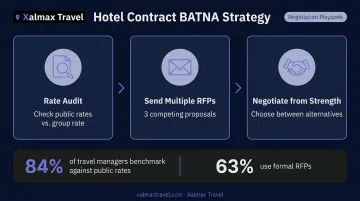
According to GBTA's 2025 research, 84% of travel managers benchmark their negotiated discounts against public rates — a simple step that fundamentally changes how you evaluate any proposal.
Apply the BATNA Principle
BATNA stands for Best Alternative to a Negotiated Agreement. In hotel contracting, it means one thing: always send RFPs to multiple properties before committing to any of them.
Having three competing proposals in hand changes the entire dynamic of a negotiation. You're no longer asking a hotel for a favor — you're choosing between alternatives. The same GBTA data found that 63% of travel managers who negotiate directly with hotels use formal RFPs as part of that process.
For planners who don't have time to manage that outreach themselves, Xalmax Travel handles the full RFP process — distributing to multiple venues and consolidating responses into side-by-side comparisons of rates, availability, meeting space, and total cost. The service is free to clients, funded by venue commissions.
Bring Your Historical Data
If your event has run before, your pickup rates, F&B spend history, and cancellation record are negotiating assets. Hotels price risk into their contracts. A group with documented low cancellation rates and consistent pickup patterns looks far more attractive than an unknown group. Show them the history.
Engage the Local CVB
If you're weighing multiple cities, contact the Convention and Visitors Bureau early. Destinations International notes that CVBs provide no-cost services to planners, including destination booking agreements and local connections that can add competitive pressure on hotels. Some CVBs also offer financial incentives — one example is the Greater Wilmington CVB, which advertises up to $7,500 in cash incentives for qualifying meetings.
Negotiating Room Rates and Hidden Fees
The room rate is the headline number, but it's rarely the full cost picture. Several charges can materially increase what your group actually pays per room night.
Hidden Fees to Identify and Negotiate
AHLA reports that approximately 6% of hotels charge resort fees, which can run $25–$50 or more per night and appear under names like "destination fee," "facility fee," or "amenity fee." For a 50-room block over three nights, that's a $3,750–$7,500 line item that has nothing to do with your room rate.
Other fees worth addressing upfront:
- Parking charges — request complimentary parking for staff and VIPs, or a flat reduced rate for attendees
- Wi-Fi fees — negotiate complimentary Wi-Fi in all meeting spaces and sleeping rooms; this is standard in most group contracts
- AV patch fees — if you bring outside AV providers, hotels often charge a patch fee just to connect to their infrastructure; request this be waived in writing
- Event/service fees — PCMA has documented cases where service fees added over 40% to F&B costs, including an 8% event fee for basic setup and cleanup
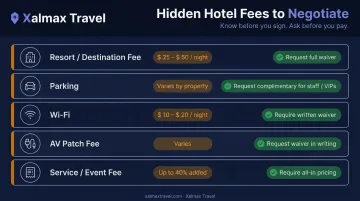
Always require all-in pricing and explicit fee-waiver language in the contract. "Complimentary Wi-Fi" means nothing if the contract doesn't specify it.
Rate Cap and Comp Room Negotiations
Two provisions that often get overlooked — rate parity and comp rooms — can add real value when negotiated correctly.
A rate parity clause ensures your contracted group rate never exceeds the lowest rate the hotel publicly offers during your event dates. If the hotel drops pricing to fill transient rooms, your group rate should drop too — or you should have the right to rebook at the lower rate.
On comp rooms: an MPI sample venue RFP requests one complimentary room per 40 room nights booked on a cumulative basis. This is a reasonable starting point for your ask — not a ceiling. Larger groups, multi-night stays, and repeat business all create grounds to improve the ratio.
Use Trade-Offs Intentionally
Every line item in a hotel contract connects to every other. Want a lower F&B minimum? Consider accepting a slightly higher room rate as the trade. Room rate is the priority? Offer a stronger F&B commitment in return. You'll get more out of a negotiation by identifying your one or two must-wins — then giving ground deliberately everywhere else.
The Three High-Stakes Clauses: Attrition, Cancellation, and Force Majeure
These three clauses are where most of the financial risk lives. A hotel contract that looks reasonable on rates can still expose your organization to significant penalties if these sections aren't addressed carefully.
Attrition Clauses
Attrition is the fee your group pays if actual room pickup falls below a contracted threshold. Hotels don't expect 100% pickup, but they do expect you to hit a minimum — and will charge for the gap.
What matters most in attrition negotiations:
- If the hotel proposes 85–90%, push toward 75–80%. The lower the threshold, the more buffer you have.
- Rather than a single cutoff, negotiate tiered release windows at 45, 30, and 21 days out — this allows gradual room releases as your actual pickup becomes clearer.
- Require mitigation language. Venable's contract guidance and Tenenbaum Legal both confirm attrition damages should be based on estimated lost profits, not gross contracted revenue — and that the hotel must actively resell unused rooms and credit that revenue against any fees owed.
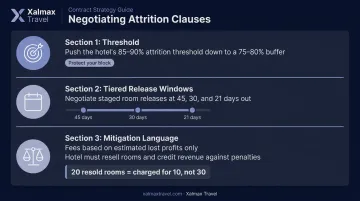
The distinction matters. A hotel that resells 20 of the 30 rooms you didn't fill should only be able to charge you for 10 rooms' worth of lost profit — not all 30 at full contracted revenue.
Attrition clauses protect you before the event. Cancellation language determines what happens if the event doesn't happen at all — and the financial exposure is often far larger.
Cancellation Clauses
Cancellation fees follow a tiered timeline: the closer to the event date, the higher the penalty because the hotel has less time to resell. For large events, these fees can reach six or seven figures under hotel-drafted language.
Key negotiation points:
- Limit fees to actual lost profits, not full projected room and F&B revenue. Venable's legal analysis is explicit that basic contract principles support this position.
- Propose a rebooking credit provision — Venable documents a clause structure where fees are waived if you hold a similarly-sized event at the same property within 12 months. Some hotels offered comparable terms post-pandemic as booking incentives.
- Specify that cancellation fees are the exclusive remedy. The contract should state explicitly that paying the fee is the hotel's sole recourse — no additional damage claims allowed.
Even well-negotiated cancellation language has limits. For true crises — pandemics, government travel restrictions, declared emergencies — force majeure is the clause that either protects you or leaves you exposed.
Force Majeure Clauses
Force majeure excuses performance when events beyond either party's control make the contract impossible to fulfill. The problem is that many hotel contracts use narrow language requiring events to be literally "illegal or impossible" — language that offers little real-world protection in most disruptions.
Tenenbaum's 2024 post-COVID guidance notes that without government restrictions, it's nearly impossible to successfully argue force majeure termination under most current hotel contract language. Push for:
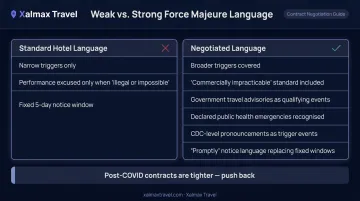
- Broader trigger language — "commercially impracticable," "inadvisable," or circumstances preventing a material percentage of attendees from traveling
- Specific named triggers — government travel advisories, declared public health emergencies, CDC-level pronouncements
- Notice flexibility — replace fixed short windows (e.g., "5 days") with "promptly" or "without undue delay" so a real-world crisis doesn't cause you to inadvertently waive your rights
Negotiating F&B, Meeting Space, and Perks
Groups with meaningful room blocks have real leverage here — but the details matter.
Meeting Space and F&B
Hotels will often waive meeting room rental fees for groups booking a significant number of room nights. Before accepting that as a win, check the fine print for:
- Setup and breakdown fees charged by the hour
- "Room flip" charges when a space is reconfigured between sessions
- Off-hours access fees if your event runs early or late
Get all of these addressed in writing. "Complimentary meeting space" means nothing if the associated fees aren't also waived.
On F&B: understand the difference between an F&B minimum (the threshold you must hit) and your projected spend — what you actually expect to spend. These often aren't the same number. If you're contracting a year in advance, negotiate a price lock on menu pricing so cost increases between signing and the event date don't erode your minimum cushion.
Perks Worth Requesting Early
Hotels frequently grant these concessions at little or no actual cost — but only when you ask upfront and confirm them in writing:
- Complimentary hospitality suite for staff use
- Discounted or complimentary room upgrades for VIPs
- Early check-in and late checkout for key attendees
- Reduced fees for room drops (in-room welcome gifts or materials)
- Complimentary breakfast for staff rooms
- Planner loyalty points credited to the booking contact
Xalmax Travel's Rewards Program extends this further. Corporate clients who book meetings, incentive programs, and hotel nights through Xalmax earn points automatically on every qualified booking — redeemable for Amazon and Visa gift cards, travel credits, Presidents Club add-ons, and meeting enhancements. Points accumulate across events within the same year, and higher-tier members earn 15–20% more on every dollar spent.
Building Flexibility and Protecting Your Room Block
Most attrition problems aren't caused by low attendance — they're caused by contracts that don't reflect how attendees actually book. Two areas demand close attention: protecting your room block from undercounting, and aligning cutoff dates to real registration patterns.
Room Block Protection
Two clauses belong in every hotel contract:
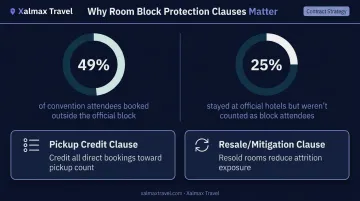
Pickup credit clause — EIC APEX's housing standards confirm that attendees who book directly with the hotel outside the official block should still be credited toward your pickup count. Require the hotel to audit registration lists against their guest manifest before applying any attrition charges.
Resale/mitigation clause — any rooms the hotel fills after your attendees cancel should count against your attrition exposure. This prevents the hotel from collecting penalty fees on rooms it's already resold.
PCMA's room block research found that 49% of convention attendees booked outside the official block, and 25% stayed at official hotels but weren't recognized as block attendees. Without a pickup credit clause, that's attrition exposure on rooms that were actually filled.
Align Timelines to Actual Behavior
If your attendees historically register two to three weeks before the event, a cutoff date six to eight weeks out will guarantee you miss your block — not because attendance dropped, but because the contract didn't match reality. Review your historical registration data and negotiate cutoff dates that reflect when your attendees actually book.
Three additional provisions add meaningful protection:
- Schedule block review windows at 90 and 60 days so you can adjust room counts before penalties kick in
- Secure name change allowances close to the event date to handle attendee substitutions without fees
- Negotiate a right-to-rebook provision that rolls any cancellation fees into a future booking at the same property within a defined window
Frequently Asked Questions
How do you negotiate a hotel contract?
Start with research — run a rate audit, gather historical group data, and collect competing proposals before any conversation begins. Then negotiate both pricing and contract terms, with particular focus on attrition, cancellation, and force majeure. The strongest negotiations use data and alternatives as leverage, not just persistence.
What are the 5 C's of negotiation?
The 5 C's — Clarity, Collaboration, Compromise, Creativity, and Commitment — apply directly to hotel contracting. Together, they guide planners from understanding real group needs, to building workable trade-offs with the hotel, to honoring what was agreed. Following through on commitments also protects your credibility for future negotiations.
What is an attrition clause in a hotel contract?
An attrition clause requires the planner to pay fees if the group doesn't fill a contracted percentage of the room block. Fees are typically calculated based on the number of unfilled rooms multiplied by the average room rate — though the legally defensible basis is estimated lost profits, not gross contracted revenue.
Can you negotiate hotel meeting room fees?
Yes. Meeting room rental fees are among the most negotiable items in a hotel contract, particularly for groups booking a meaningful number of room nights. Setup, breakdown, room flip, and off-hours access charges should also be addressed explicitly — not just the base rental fee.
What is force majeure in a hotel contract?
Force majeure excuses performance when events beyond either party's control make it impossible or impracticable — but since 2020, hotels have tightened this language considerably. Push for specific named triggers like government travel advisories and public health emergencies, rather than accepting narrow "illegal or impossible" language.
When is the best time to negotiate a hotel contract?
Your leverage peaks when three conditions align: you're booking 12+ months out, you have competing proposals in hand, and you're reaching out during the hotel's off-peak booking period. Urgency works against you — the closer your event date, the less flexibility hotels have reason to offer.