Introduction
Hotel costs are rising. According to GBTA and CWT, global hotel average daily rates climbed 1.9% to $161 in 2024, with North America averaging $188 — and rates are forecast to keep climbing through 2026.
But rising market rates aren't the core problem. Most corporate hotel overspend traces back to a handful of fixable problems: employees booking outside approved channels, rates negotiated without volume data to back them up, ancillary fees going untracked, and group blocks managed like individual travel.
This guide covers three dimensions of corporate hotel costs — how rates are structured, what pushes costs higher, and the strategies that bring them down — so you can address each layer directly rather than just react to the invoice.
Key Takeaways
- Most hotel overspend originates from fragmented booking decisions, not just market rate increases
- Negotiated corporate rates (CNRs) typically start at 10% off rack rate — but volume data can push savings significantly further
- Bundling amenities like breakfast and parking into negotiations cuts total trip cost — not just the nightly rate
- Negotiated rates only save money when employees actually use them — compliance is where most programs lose ground
- Group room blocks for meetings and retreats follow different negotiation rules than individual travel
How Corporate Hotel Costs Typically Build Up
Hotel costs rarely appear as one clean line item. They accumulate across individual bookings made through different channels — each with its own rate structure, fee schedule, and compliance level.
The Fragmentation Problem
BCD Travel defines hotel leakage as bookings made outside policy, and the consequences compound quickly: higher costs, fragmented data, weakened negotiating power, and safety blind spots. When volume is scattered across OTAs, direct hotel sites, and personal booking preferences, there's nothing concrete to present in a negotiation.
For a corporate event planner or admin assistant managing multi-city travel, this plays out as a steady accumulation of small decisions that are individually defensible but collectively expensive.
Hidden Costs That Compound Over Time
A significant portion of hotel cost stays invisible until you aggregate it. Common culprits:
- Resort and destination fees often run $30–$60 per night and are rarely included in the quoted rate
- Parking is mandatory at many urban properties, frequently adding $40–$80 per night
- Wi-Fi fees — still charged at some business hotels despite being standard elsewhere
- Last-minute rate inflation hits when multiple employees converge on the same city without a coordinated room block
None of these feel significant per stay. Across a full year of corporate travel, they represent real budget exposure.
Key Cost Drivers for Corporate Hotel Rates
Booking Fragmentation Destroys Negotiating Leverage
The primary cost driver isn't room rate — it's how bookings are distributed. When employees self-book across different platforms, the company loses the concentrated volume that hotels use to evaluate CNR proposals.
CWT data shows exactly how much this matters:
| Annual Room Nights at Property | Average Negotiated Discount |
|---|---|
| Fewer than 50 nights | ~3% |
| 50–149 nights | ~8–10% |
| 150–199 nights | ~15% |
| 300+ nights (gateway cities like NYC) | ~15%+ |
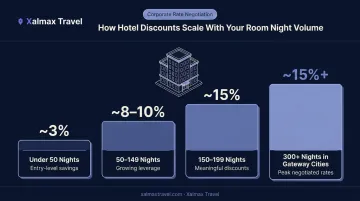
The gap between 3% and 15% isn't a negotiation skill problem — it's a volume visibility problem. Hotels increasingly decline to bid on corporate RFPs without sufficient room night commitments. CWT reported an average 11% decline-to-bid rate for corporate RFPs, with one buyer logging 93 bid declines in a single year.
Destination, Timing, and Lead Time
Rate volatility peaks when multiple unfavorable factors overlap — a last-minute booking in a high-demand city during a major conference week, for example. These factors are partly within your control:
- Destination selection affects the rate baseline (major metros command higher ADRs)
- Booking lead time influences available inventory and pricing flexibility
- Seasonal demand creates predictable high and low windows you can plan around
CWT notes that aggregator content can capture better rates during slower months like January and July — worth factoring in when scheduling has any flexibility.
Company Size Is a Real Disadvantage — But Not a Fixed One
Those controllable factors only get you so far if the underlying volume isn't there. Smaller companies face a structural challenge: without the room nights to commit, they can't access the rates that enterprises take for granted. Hyatt's Leverage program illustrates the entry point — the program is open to companies achieving at least 50 nights annually at Hyatt properties, offering up to 15% off standard rates.
That's a realistic threshold for many mid-sized businesses. The key is that consolidating bookings — changes the negotiating position. The next section covers the specific strategies that make consolidation work in practice.
Cost-Reduction Strategies for Corporate Hotel Rates
Effective strategies depend on where the cost originates. Some target decisions made before booking. Others improve how existing agreements are managed. A third category addresses structural constraints — volume limitations, demand timing, and the specialized mechanics of group travel.
Strategies That Change Decisions Before Booking
Consolidate hotel spend before you negotiate. Hotels offer deeper discounts based on guaranteed night counts. If your company books 200 room nights annually but spreads them across 15 properties with no coordination, none of those hotels sees you as a significant account. Aggregating room nights — including individual travel, meetings, and retreats — into a coherent volume story is what makes a CNR proposal credible.
Negotiate with data, not assumptions. Before contacting a hotel sales team, pull together your top destinations, average stay durations, preferred tiers, and seasonal patterns. A data-backed proposal shifts the conversation from "can we get a discount?" to "here's what a 12-month partnership looks like." Corporate rates typically start around 10% off rack rate, but programs with strong volume data and clear commitment often reach the industry average of 23% off BAR, with strong-volume negotiations reaching 15–49% off.
Negotiate beyond the nightly rate. The room rate is one variable. According to BCD Travel's rate inventory data, Wi-Fi is included at 78% of preferred properties, fitness access at 63%, parking at 50%, and breakfast at 46%. Each of these carries real per-stay dollar value. Complimentary parking alone, at $50 per night in an urban market, can represent $250 in savings on a five-night trip — before touching the room rate.
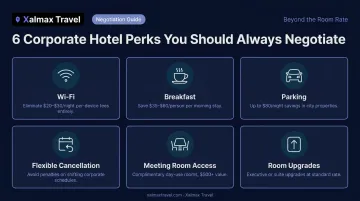
Key perks worth including in any CNR negotiation:
- Complimentary Wi-Fi
- Breakfast inclusion
- Parking (especially in high-cost cities)
- Flexible cancellation windows
- Meeting room access for day-of business needs
- Room upgrade eligibility for extended stays
Match rate type to travel predictability.
- Flat rates — fixed regardless of demand — work best for predictable, recurring routes where employees travel on consistent schedules
- Volume-discounted rates — scale with booking frequency and reward programs that hit their committed room nights
- Dynamic pricing — fluctuates with demand; it can save money when booked well in advance during low-demand periods, but requires active monitoring
Strategies That Change How Rates Are Managed
Centralize booking and embed corporate codes. A negotiated rate generates zero savings if employees never see it. When booking happens across multiple platforms, corporate codes don't surface automatically — and employees default to whatever's visible. Centralizing hotel booking through one approved platform ensures preferred properties and corporate rates appear at the point of purchase, not as an afterthought.
Run rate audits at least quarterly. A rate negotiated 12 months ago may no longer be competitive. A basic audit compares your contracted rates against current market rates for the same properties and travel windows. For a travel manager or admin assistant, this means pulling the top 10 properties by room night spend, checking current rates on OTAs for your typical booking window, and flagging properties where the gap has narrowed or reversed.
Most programs renegotiate annually. Quarterly monitoring catches drift before it compounds.
Diagnose non-compliance before adding enforcement. Non-compliant bookings are usually a symptom, not a character flaw. CWT found that 52% of travel managers believe travelers book outside policy because they prefer a non-preferred brand or hotel type. Common root causes:
- Better rates visible elsewhere at booking time
- Loyalty point concerns when booking through a corporate tool
- An approval process that's too slow relative to booking urgency
- Unfamiliarity with the approved booking tool
Addressing the cause — updating preferred inventory, confirming loyalty eligibility, simplifying the booking flow — is more effective than adding friction to the non-compliant path.
Stack loyalty benefits on top of negotiated rates. Many hotel chains allow loyalty points to accrue on corporate negotiated rates, provided the rate qualifies and the booking channel is approved. This matters for two reasons: employees earn status, upgrades, and free nights without additional spend, and they have a reason to stay within the corporate channel.
The caveat is real. These major programs all exclude certain rate structures from point earning — particularly master-billed group arrangements:
- Marriott Bonvoy
- Hilton Honors
- IHG One Rewards
- World of Hyatt
Confirm that each corporate rate is a qualifying rate before communicating loyalty eligibility to employees.
Strategies That Change the Context Around the Booking
Use off-peak timing and advance booking windows strategically. Shifting a meeting by two to three weeks — from a conference-heavy window to a lower-demand period — can produce meaningful rate reductions with no impact on the agenda. Mid-week dates consistently outperform weekend-adjacent windows in rate competitiveness. CWT specifically identifies January and July as months when aggregator content can capture better rates due to lower travel demand.
Work through a sourcing partner for volume you don't have alone. Smaller and mid-sized businesses often lack the room night volume to access enterprise-tier rates through direct negotiation. Sourcing partners and consortia pool collective booking power across multiple clients to unlock those rates on each client's behalf.
For corporate meetings and retreats specifically, Xalmax Travel provides a free venue and hotel sourcing service that handles RFP distribution, proposal comparison, room block negotiation, and contract review — including attrition, cancellation, and force majeure clauses. The service is funded by hotel and venue commissions, so there's no cost to the client. For event planners, sales managers, and administrative assistants who would otherwise spend days managing this manually, that's days of sourcing work eliminated.
Treat group room blocks as a separate negotiation category. Group blocks — typically 10 or more rooms — operate under fundamentally different contract mechanics than individual CNRs. Marriott's standard group conditions allow a 10% wash allowance, with attrition damages on adjusted minimum revenue. Cancellation fees escalate from 20% of total revenue at 120+ days out to 100% within 13 days of arrival.
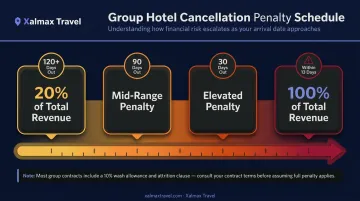
Applying standard corporate rates to a group booking ignores this entirely different risk structure. Dedicated group negotiation — with attention to attrition clauses, complimentary room ratios, bundled meeting space, and F&B minimums — can unlock better terms and avoid penalties that standard CNRs never contemplate.
Frequently Asked Questions
What are corporate hotel rates?
Corporate hotel rates are negotiated prices offered by hotels to businesses in exchange for consistent booking volume. They typically provide a discount off the standard rack rate, along with perks like flexible cancellation, complimentary Wi-Fi, or breakfast — formalized in a rate agreement accessed via a corporate code or booking portal.
How do I get a corporate hotel rate?
Approach a hotel's sales team with data on your projected room nights, preferred stay patterns, and top destinations. Negotiate a rate agreement — typically starting around 10% off rack rate — formalize the terms in a contract, and give employees access through a corporate code or approved booking platform.
Are corporate hotel rates always cheaper than public rates?
Not always. Corporate rates are typically lower than the published rack rate, but OTA deals and public promotions can sometimes beat them. Compare your contracted rate against current market prices before assuming the negotiated price wins — a quarterly rate audit makes this easy to do consistently.
Can small businesses access corporate hotel rates?
Yes, though with less leverage than larger companies. Small businesses can access competitive rates by consolidating bookings to build visible volume, enrolling in programs like Hyatt Leverage (50 annual nights minimum), or working through a sourcing partner that pools volume across clients.
What is the 15/5 rule in hotels?
The 15/5 rule is a hospitality service standard: staff acknowledge guests at 15 feet with eye contact and offer a verbal greeting at 5 feet. For corporate travelers, it signals the level of attentiveness to expect at business-class properties.
What perks can businesses negotiate alongside a lower room rate?
Commonly negotiated perks include complimentary breakfast, free parking, Wi-Fi, flexible cancellation terms, room upgrades, and meeting room access. For extended-stay travelers and high-frequency routes, these inclusions can represent as much value as the rate discount itself.