& Offsites](https://file-host.link/website/xalmaxtravel-f2l7e9/assets/blog-images/24931c18-bc2d-43bd-9958-701b2130f8cd/1779919548925534_f6e937298e6e45cd9bbe45d35d2a4689/360.webp)
Introduction
Corporate retreats have come a long way from two-day off-site meetings crammed with PowerPoint slides. Today, they're strategic investments. The team building exercises you choose will determine whether your team returns energized and aligned — or simply relieved to be back at their desks.
The stakes are higher than ever. Gallup reports that in 2024, 52% of U.S. remote-capable employees worked hybrid and 26% worked exclusively remote — meaning for many teams, a retreat is one of the few opportunities each year for genuine in-person connection.
This guide covers the most effective team building exercises for corporate retreats, how to sequence them for maximum impact, and the planning decisions that shape everything else.
Key Takeaways
- Team building exercises build specific workplace skills: communication, trust, problem-solving, and leadership — not just morale.
- Effective retreat agendas blend 3–4 activity types, progressing from low-stakes icebreakers to more complex challenges.
- Activities fall into three categories: icebreakers, indoor challenges, and outdoor experiences.
- Match exercises to your team's actual pain points, not what's trending.
- Venue capability is the most constraining — and most overlooked — factor in retreat planning.
Why Team Building Retreats Actually Work
Remove people from their usual seats and something shifts. Routine hierarchy loosens, social defensiveness drops, and colleagues who've shared a conference room for years start actually talking to each other.
The research supports this. Google's Project Aristotle found that psychological safety was the single most important factor distinguishing high-performing teams — ahead of talent, resources, or strategy. Well-designed retreat activities directly build that safety by creating low-risk conditions for authentic interaction.
A meta-analysis published in the Academy of Management Annals confirmed that structured team building produces meaningful positive effects across team outcomes — with the strongest gains in affective and process outcomes. Interventions focused on role clarification and goal-setting showed the most consistent results.
That distinction between structured and unstructured matters more than most retreat planners realize. It's also where a lot of offsites quietly underdeliver.
Team Building vs. Team Bonding — Know the Difference
These terms get used interchangeably, but they're not the same thing:
- Team building is structured and goal-oriented — developing specific skills like communication, decision-making, or conflict resolution
- Team bonding is informal and camaraderie-focused — shared meals, social events, casual time together
- "Offsite" can refer to either, or a mix of both
The best corporate retreats include both. Structured activities build the skills; informal time together is what makes those skills transfer back to the office. One without the other tends to fade quickly.
What to Plan Before Picking Your Activities
Activity selection is the fun part. But if you skip the planning steps below, you'll end up booking activities that don't fit your venue, your group, or your actual goals.
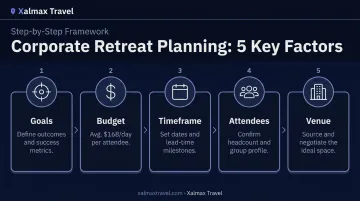
The Five Planning Factors
Settle these before you look at a single activity option:
- Goals — What specific team challenge is this retreat solving? Poor cross-functional communication? Low trust after a reorg? Leadership development?
- Budget — Per-person costs covering activities, transportation, meals, and lodging. The CWT/GBTA 2026 forecast pegs average meetings and events cost at $168 per attendee per day in 2025, rising to $172 in 2026.
- Timeframe — Half-day, full-day, or multi-day? Each format supports a different depth of programming.
- Attendees — Group size, physical abilities, dietary restrictions, and whether you're mixing remote and in-office employees.
- Venue — What facilities and surroundings does the property actually offer?
Why Venue Is Your Most Constraining Factor
Most planners finalize their activity list first, then hunt for a venue — and that's exactly backwards.
Venue capability determines what's possible:
- Cooking classes require professional kitchen facilities
- Outdoor adventure activities require appropriate natural terrain
- Large-group exercises need adequate open space and breakout rooms
Sorting out venue fit after the fact wastes weeks of research and often forces a compromise on activities. Xalmax Travel's free venue sourcing service works the other direction: planners share their activity list, group size, and budget, and Xalmax identifies properties that actually support all three. The service costs nothing to planners, since hotel commissions cover it.
Logistics Do's and Don'ts
| Do | Don't |
|---|---|
| Give attendees ample advance notice | Overschedule — buffer time matters |
| Plan accessibility accommodations upfront | Assume all activities work for all attendees |
| Confirm dietary restrictions before food-involved activities | Finalize activities before confirming venue capabilities |
| Build in transition time between activities | Stack major exercises back-to-back without breaks |
Top Team Building Exercises for Corporate Retreats & Offsites
The exercises below are organized by setting and format — mix categories to build a retreat agenda that covers both high-energy and strategic moments.
Icebreaker Activities
Every retreat agenda should open with an icebreaker. The reason is practical: people who don't speak or contribute in the first few minutes are significantly less likely to speak up later. Get people talking early, and you prime the group for everything that follows.
Three high-impact options:
- Two Truths and a Lie — Participants share three statements about themselves; the group identifies the fabricated one. Builds empathy and listening while revealing unexpected personal details.
- Human Bingo — Participants find colleagues matching trait-based bingo squares, driving interaction across teams and departments that wouldn't otherwise mix.
- Team Trivia — Tests shared company or project knowledge and sparks discussion. Works especially well for newly merged teams or cross-functional groups.
At a glance: 15–30 minutes | Minimal materials | Low or no cost | Zero risk as an agenda opener
Indoor Team Building Exercises
Escape Room Challenge
Teams work within a time limit — typically 60 minutes — to solve themed puzzles and uncover clues in order to "escape." Can be run at an external venue or replicated on-site using a virtual escape room platform for hybrid teams.
The format naturally surfaces how different people lead under pressure. Analytical thinkers, creative problem-solvers, and observational personalities all contribute in different ways — and the team sees exactly how they function together when the clock is running.
At a glance: 60–90 minutes | 4–10 per team (scalable with multiple rooms or virtual instances) | Best for: problem-solving under pressure, leadership identification, communication
Cooking Class Workshop
Participants divide into small groups, each responsible for one component of a shared meal — appetizer, entrée, or dessert — facilitated by a professional chef at a venue with kitchen facilities.
The structure mirrors real workplace dynamics more closely than most people expect: task division, time pressure, resource constraints, and cross-group coordination under a shared deadline. The communal meal that follows also extends the bonding effect beyond the activity itself.
At a glance: 2–3 hours | 10–50 participants | Best for: collaboration, communication, cross-functional bonding
Business Case Study Simulation
Teams receive a realistic business scenario — a past company challenge, an industry problem, or a hypothetical — along with relevant data and constraints. They analyze the situation, debate solutions, and present their recommended course of action.
Unlike entertainment-focused exercises, this one directly develops strategic thinking and draws on each participant's professional expertise. Harvard Business Publishing uses simulations in MBA and Executive Education for exactly this reason: they let participants make decisions under pressure in a risk-free environment. A well-designed simulation can even surface ideas the company actually implements — giving it measurable ROI beyond morale.
At a glance: 2–4 hours | 5–8 per team | Best for: strategic thinking, cross-functional collaboration, decision-making
Outdoor Team Building Exercises
Scavenger Hunt
Teams follow a sequence of clues — riddles, codes, physical challenges, or GPS waypoints — across the retreat property or surrounding area. Content can be customized to company values, history, or strategic priorities to make the exercise directly relevant rather than generic.
It forces interaction between employees who don't normally work together, maintains high group energy throughout, and introduces a competitive element that motivates full participation — all without requiring a dedicated facilitator.
At a glance: 1.5–3 hours | 5–10 per team (works for any total group size) | Best for: cross-team bonding, creative problem-solving, communication
Human Knot
Participants stand in a circle, each grabbing the hands of two different people across the circle. The group must untangle itself into an unbroken circle without releasing any hands — using only verbal and physical coordination.
It needs no materials, no budget, and no advance setup — making it a reliable spontaneous energizer mid-retreat. It also reliably generates authentic laughter while revealing how teams instinctively communicate when the path forward isn't clear.
At a glance: 15–30 minutes | 8–20 participants | Best for: communication, patience, collaborative coordination
Outdoor Adventure Activities
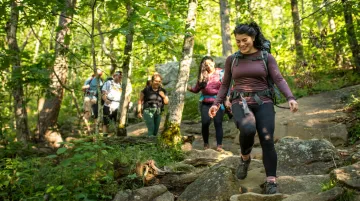
Guided hiking, kayaking, biking, or ropes courses — organized around the retreat venue's natural surroundings and divided into fitness-appropriate groups to keep the experience inclusive.
The team building value is well-supported: a 2019 study in Frontiers in Psychology found that nature experiences reduced salivary cortisol by 21.3% per hour beyond natural diurnal changes, with stress relief most efficient between 21 and 30 minutes of exposure.
Beyond stress reduction, shared physical challenges create organic leadership moments — navigating terrain, supporting slower group members — that produce a sense of collective achievement indoor activities rarely match.
At a glance: 2–6 hours | Any size (divided by fitness level) | Best for: camaraderie, stress relief, leadership in unfamiliar environments
How to Choose the Right Activities for Your Team
Diagnose First, Then Select
The most common planning mistake: choosing activities based on popularity rather than diagnosing what the team actually needs. Booking a high-energy outdoor competition when the real issue is poor cross-departmental communication, or a lack of psychological safety, won't move the needle.
Before selecting any activity, audit your team's pain points:
- Where do breakdowns most often occur — in communication, decision-making, or execution?
- Are there trust gaps between specific departments or levels?
- Is the team newly formed, recently reorganized, or dealing with remote collaboration challenges?
The activities that best address those specific gaps are your starting point. Once you know what you're solving for, the next question is order.
Sequence Your Agenda Deliberately
The order of activities matters as much as the activities themselves:
- Open with a low-stakes icebreaker to establish rapport and psychological safety
- Transition into a trust-building or creative activity while energy is fresh
- Reserve complex problem-solving or competitive exercises for when the group is warmed up and comfortable
- Close with a debrief before moving to the next major activity
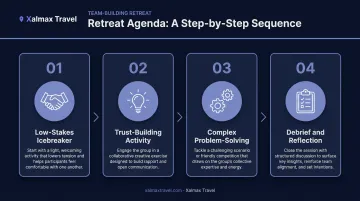
Most effective retreat programs combine three to four activity types — enough variety to address different team dynamics without overloading the agenda.
Don't Skip the Debrief
A 10–15 minute facilitated reflection after each major exercise — asking what worked, what was challenging, and how it connects to real team behaviors — sharply increases how much sticks once the team is back at work. The same meta-analysis that documented team building's effects found that team debriefs improved performance by approximately 25% versus control groups.
Good debrief questions:
- What role did you naturally take on during that exercise?
- Where did the team get stuck, and how did you work through it?
- What would you do differently — and how does that apply to how we work day-to-day?
Plan for Every Participant From the Start
- Verify every chosen activity can be adapted for physical limitations
- Build in introvert-friendly options at each stage of the agenda
- Confirm dietary restrictions well in advance of any food-based activities
- Have participation alternatives ready for anyone who can't engage with the primary activity
Conclusion
The most effective corporate retreat doesn't hinge on one impressive activity. It builds a deliberate arc: icebreakers that create safety, trust-building exercises, creative challenges, and complex problem-solving — layered together to produce real change in how teams communicate and work.
The foundation of that arc is finding a venue that supports your chosen activities, fits your group, and stays within budget. That search can take weeks of research and vendor outreach. Xalmax Travel offers a completely free venue sourcing service, matching corporate retreat planners with properties across California, Colorado, and beyond, tailored to your exact activity requirements, group size, and budget.
Contact Xalmax at customerservice@xalmax.com or 347-688-2572 to start planning.
Frequently Asked Questions
What is a team building retreat?
A team building retreat is a structured off-site event where employees participate in goal-oriented activities designed to improve collaboration, communication, and trust. It differs from a standard work conference because the focus is on interpersonal development and team dynamics, not business updates or presentations.
What's the average cost of a corporate retreat?
Costs vary based on group size, location, duration, and activity choices. The CWT/GBTA 2026 forecast reports an average meetings and events cost of $168 per attendee per day in 2025, rising to $172 in 2026. Venue sourcing services like Xalmax Travel are free to corporate clients and can stretch that budget further by negotiating competitive rates directly with hotels and venues.
What's the difference between team building and team bonding?
Team building is structured and goal-oriented, focusing on specific skills like communication or problem-solving. Team bonding is informal and camaraderie-focused, such as shared meals or social events. Effective retreats incorporate both, and the term "offsite" typically refers to a combination of the two.
How long should a corporate retreat team building session last?
Common formats run 2–4 hours for focused half-day programs, 6–8 hours for full-day retreats, and multi-day events that progressively layer activities. The right length depends on travel distance, group size, and the complexity of goals being addressed.
What are the best team building activities for large groups?
Scalable options for groups of 50 or more include scavenger hunts (any number of teams), cooking class competitions (station-based format handles large numbers), and outdoor adventures divided by fitness level. All three maintain engagement without requiring the full group to operate as one unit.
How do you measure the success of team building activities?
Key indicators to track include:
- Pre- and post-retreat surveys on communication and psychological safety
- Employee engagement scores in the following quarter
- Qualitative feedback from post-activity debriefs
- Longer-term signals like collaboration quality and retention rates