The problem usually isn't the people in the room. It's the absence of a deliberate framework that connects strategic discussion to operational reality.
This guide covers exactly that framework — purpose-setting, agenda design, venue selection, pre-offsite preparation, and post-event follow-through. Whether you're a CEO, chief of staff, or EA running point on this event, you'll leave with a clear picture of what separates an offsite that generates lasting change from one that generates a recap email.
Key Takeaways
- Lock the purpose before touching logistics — vague mission equals wasted time
- Two full days is the right duration; quarterly cadence aligned to goal cycles is the right rhythm
- The 40-20-40 framework keeps agendas balanced — split between reviewing the past, assessing current state, and planning forward
- Pre-work sent one week out allows executives to arrive thinking strategically, not catching up
- Offsite commitments rarely survive the first week back without a concrete accountability plan in place
What Is a Leadership Offsite (and Why It's Not Just a Long Meeting)
A leadership offsite is a structured, off-premises gathering of the senior leadership team — typically C-suite executives, department heads, and a chief of staff — held outside the daily work environment to focus on strategy, alignment, and forward planning.
The "off-premises" part is more than symbolic. Research published in Nature by Brucks and Levav found that videoconferencing narrows cognitive focus and curbs creative idea generation compared to face-to-face interaction. Physical separation from the office produces a similar effect — it helps leaders break reactive patterns and surface the strategic priorities that weekly cadence meetings routinely crowd out.
McKinsey research found a 1.9x increased likelihood of above-median financial performance when leadership teams work toward a common vision — which is precisely what a well-run offsite is designed to build.
How It Differs from Other Gatherings
Executive offsites are frequently confused with team offsites or all-hands meetings — and conflating them leads to the wrong format, wrong venue, and wrong agenda. Here's how they differ:
| Format | Group Size | Primary Focus | Tone |
|---|---|---|---|
| Executive offsite | 5–10 leaders | Strategy, alignment, confidential decisions | High-stakes, structured |
| Team offsite | 15–50+ | Cross-functional collaboration, culture | Collaborative, social |
| All-hands | Company-wide | Communication, transparency | Broadcast-heavy |
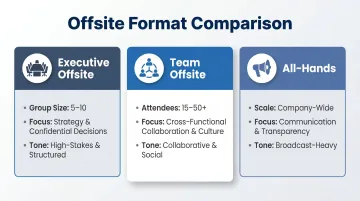
The executive offsite is deliberately smaller and more confidential. That small group size is what makes candid, high-stakes conversation possible in the first place.
Laying the Groundwork: Purpose, People, and Timing
Start with the Objective
Offsites fail most often when the room is filled but the mission is vague. Before any logistics are touched, the convener needs to answer one question: What must this offsite accomplish that cannot happen any other way?
Distinct objectives shape everything downstream:
- Annual strategy planning — backward-looking review, heavier use of external data, and likely an external facilitator
- Quarterly goal alignment — tighter agenda focused on execution review and forward commitments
- Organizational redesign — requires psychological safety, structured dialogue, and careful management of hierarchy
- Crisis response — compressed format, decision-focused, minimal retrospective content
Getting this right before booking a venue prevents costly rework.
Attendance Decisions
Every member of the executive team should be present, including the CEO. An offsite without the CEO sends an unmistakable signal about its actual priority level.
Beyond the core team, consider:
- Chiefs of staff — appropriate when they function as key operators of the strategic plan
- High-potential leaders — valuable for succession planning sessions, but brief their role explicitly
- External facilitators — worth evaluating for any high-stakes or politically sensitive agenda
On group size: Research consistently shows that team effectiveness drops when groups exceed ten members, as sub-teams form and undermine collective ownership. Keep the list tight.
Scheduling and Cadence
Quarterly is the right rhythm — it aligns naturally to goal-setting cycles and creates consistent strategic checkpoints. The ideal timing is 2–3 weeks after quarter-end, giving enough time to review actual results before the group convenes.
Plan for two full days. One day rarely provides enough depth for both review and forward planning. Three or more days risks losing executive focus and creates real strain on the direct reports holding operations together.
Lock dates a full year in advance and treat them as non-negotiable.
Facilitation: CEO-Led vs. External
The choice between a CEO-led offsite and an external facilitator involves a genuine tradeoff:
- CEO-led: Keeps authority in the room and moves faster. The tradeoff — hierarchy tends to suppress honest dissent, and the CEO can't fully contribute while managing process.
- External facilitator: Neutralizes status dynamics and consistently unlocks more candid dialogue. An impartial observer can surface when the group isn't actually aligned — something insiders often miss.
Use an external facilitator when the agenda involves sensitive organizational issues, when trust levels are low, or when the CEO needs to be a full participant rather than a moderator.
Designing an Offsite Agenda That Drives Strategic Outcomes
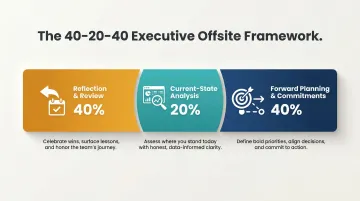
A strong offsite agenda balances backward-looking review with forward-looking planning. A useful lens is the 40-20-40 framework: roughly 40% of time on reflection and review, 20% on current-state analysis, and 40% on forward planning and commitments. This prevents the day from collapsing into either a retrospective or a wishlist session.
Opening: SWOT Analysis
Starting with a SWOT analysis gets everyone contributing from the first session and gives the team a shared, unvarnished read on where the business actually stands. The facilitation challenge is pushing past diplomatic answers on weaknesses and threats.
One technique: after completing each quadrant, allow 30 seconds of silence before moving on. Most groups fill silence with their most honest observations.
Note that HBR has argued that starting with external factors (opportunities and threats) before internal ones reduces "inside-out" bias — worth considering when market conditions are shifting rapidly.
Strategic Plan and Previous Quarter Review
Pull up the company's mission, vision, core values, and 2–3 year objectives. For most quarterly offsites, this is reinforcement rather than rewriting — but the team should explicitly ask whether recent events have shifted any of these.
Follow with the previous quarter review:
- Which goals were achieved?
- Which were missed, and what did that reveal?
- What needs to roll over into the next quarter?
Teams that openly examine misses — not just celebrate wins — make faster, better-calibrated decisions going forward.
Forward Planning: Goals and Rolling Documents
The current quarter goals session should pressure-test new commitments against SWOT insights, the strategic plan, and lessons from last quarter.
Beyond quarterly goals, update three rolling 12-month planning documents during the offsite:
- Budget — aligned to shareholder expectations
- Hiring plan — aligned to team and operational needs
- Customer value or product roadmap — aligned to customer commitments
Reviewing all three together forces trade-off conversations that siloed planning sessions almost never produce.
Team Development Session
Team building at an executive offsite doesn't need to be theatrical. One structured session focused on interpersonal understanding is enough — and more useful than the alternative.
Effective formats include:
- CliftonStrengths or DISC workshop — surfaces communication styles and reduces friction in high-stakes debates
- "User Manual" exercise — each executive shares a short document describing their working style, decision-making preferences, and what drains them
- "Who Am I?" conversation — for teams with newer members, structured personal sharing that builds context faster than months of observation
The goal is relational trust that makes strategic debate more productive, not social bonding for its own sake.
Common Agenda Pitfalls
Two patterns consistently undermine executive offsites:
1. The "United Nations meeting" — Patrick Lencioni's term for executive sessions where each leader delivers a department update and functions as a lobbyist for their own function rather than a member of a unified leadership team. This turns colleagues into representatives and produces reports, not decisions.
Fix: Replace reporting blocks with cross-functional decision sessions. Ask "What do we need to decide together?" — not "What does each team want to share?"
2. No follow-through infrastructure — Decisions without named owners and deadlines rarely survive the first week back. Before the room clears, every key decision needs an assigned owner and a committed deadline. That single step is what separates a productive offsite from an expensive conversation.
Selecting the Right Venue for Your Executive Offsite
The venue isn't a backdrop — it shapes the quality of conversation before a word is spoken. Executive offsites have different requirements than team retreats, and conflating the two undermines the tone.
Core Venue Requirements
For an executive session, prioritize:
- Acoustic privacy for confidential conversations
- Enclosed breakout rooms for sub-committee work between plenary sessions
- Full AV and hybrid capability if any participants are remote
- Reliable high-speed Wi-Fi throughout all meeting spaces
- Controlled lighting and temperature — these details affect focus more than most planners expect
- A setting that signals "this is different," not a rebranded conference room in your own building
Team offsites call for open floor plans, writable walls, and modular furniture. Using that kind of space for an executive session sends the wrong signal before anyone sits down.
Location: Destination vs. Urban Premium Space
| Option | Best For | Trade-offs |
|---|---|---|
| Private ranch / boutique resort | Annual planning, multi-day retreats | Higher cost, more travel coordination |
| Nature retreat / secluded hotel | Deep focus, organizational reset sessions | Distance from operational teams |
| Premium urban meeting space | Quarterly offsites, same-city teams | Easier logistics, less psychological separation |
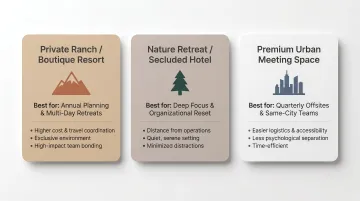
For annual or multi-day planning, getting executives fully out of their operational environment is worth the added travel complexity. For quarterly sessions, a premium private space within the company's city is often the practical choice.
What to Evaluate in a Specific Venue
- Capacity relative to group size — executives need roughly 25–30 square feet per person for a comfortable working environment
- Catering flexibility and dietary accommodation
- On-site support staff availability
- Parking or transit access for executives traveling from different parts of the city
- Room configuration options for plenary versus breakout formats
Venue sourcing is one of the most time-consuming parts of offsite planning: hours of research, back-and-forth with hotel sales teams, and proposals that are rarely comparable. Xalmax Travel handles that process for you — submit your group size, budget, city, and requirements, and their team delivers tailored venue proposals at no cost. Venues pay their commission directly, so there's no fee on your end.
Pre-Offsite Preparation That Sets the Team Up to Succeed
HBR research establishes a strong correlation between meeting preparation and likelihood of success. For an executive offsite, pre-work isn't optional — it's the difference between executives arriving in strategic mode versus spending the first two hours catching up.
The Pre-Work Package
Send this to all attendees one week before the offsite:
- Latest 1-page strategic plan
- Previous quarter goal results (actuals vs. targets)
- Current quarter goal drafts for pressure-testing
- Completed SWOT worksheet
- Relevant financial or operational data
- Talent or personality assessments if a team development session is planned
Executives who receive a focused 5-page brief consistently arrive better prepared than those handed a 40-page pre-read deck. Keep it tight.
Logistics Checklist
The day itself should be protected from operational friction:
- Confirm AV setup and test hybrid call capability 24 hours in advance
- Confirm catering and collect dietary requirements in advance
- Set and communicate ground rules — phones away, laptops closed during sessions, no interruptions for routine operational issues
- Assign one person to track decisions in real time and draft the post-offsite summary
Group Travel Coordination
When executives are flying in from multiple locations, centralized travel booking prevents scheduling conflicts and eliminates late-booking surcharges. Assign a dedicated logistics owner — separate from whoever is managing the agenda — to handle:
- Flight and hotel coordination across all attendees
- Ground transportation to and from the venue
- Contingency plans for delays or cancellations
Turning Offsite Conversations Into Lasting Action
The most common failure mode isn't a bad offsite — it's a good one with no follow-through system. When normal operations resume, priorities blur, urgency takes over, and the commitments made in a conference room two weeks ago feel distant.
The Post-Offsite Summary
Within 48 hours of the offsite, distribute a summary document to all attendees covering:
- Decisions made — stated clearly and specifically
- Initiatives approved — with scope and rationale
- Owners assigned — one named person per commitment
- Deadlines committed — specific dates, not "next quarter"
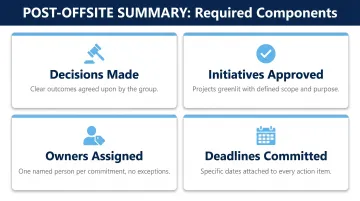
This document should be integrated into weekly executive team meetings for the following quarter. Without a standing place in the operational cadence, offsite commitments get displaced by day-to-day demands before they gain traction.
Communicating to the Broader Organization
Employees notice when the leadership team disappears for two days. Silence breeds speculation about what was decided and why.
A brief post-offsite communication to the company doesn't require disclosing confidential strategy. It should cover:
- Why the team meets regularly in this format
- The general themes addressed (goal review, forward planning, team alignment)
- Any decisions that affect the broader organization
- What employees can expect in terms of follow-up
That transparency builds trust, not anxiety. It tells employees that leadership is solving problems at the strategic level — and that the offsite produced decisions, not just discussions.
Frequently Asked Questions
What is a leadership offsite?
A leadership offsite is a structured gathering of a company's senior leadership team — typically C-suite and department heads — held outside the daily work environment for strategic planning, goal alignment, and forward-looking decisions. The off-site setting is deliberate: physical distance from the office helps shift the team from operational to strategic thinking.
What is the purpose of an offsite meeting?
The core purpose is breaking executives out of reactive mode and creating space for strategy and alignment that operational calendars don't allow. A well-run offsite also strengthens the trust and candid communication that make high-stakes decisions possible.
How much does an executive offsite cost?
GBTA/CWT data puts the average daily cost per attendee at $162 in 2024, rising to ~$169 in 2025. Executive offsites run higher due to venue exclusivity, business-class travel, and external facilitation. Venue sourcing services like Xalmax Travel can help optimize spend — at no cost to you.
What questions should leadership teams address at an offsite?
High-value questions include:
- What are our biggest threats this quarter that we're not discussing openly?
- Are our current goals aligned with our 2–3 year strategic objectives?
- Where is decision-making breaking down, and who should own it?
- What did we say we'd do last quarter that we didn't — and why?
What are examples of offsite activities?
Strategic options include SWOT workshops, quarterly goal reviews, strategic plan refreshes, and rolling 12-month planning sessions. For team development, consider CliftonStrengths workshops, DISC sessions, or a "User Manual" sharing exercise — but keep the emphasis on strategic depth, not trivia nights.
What is the 40-20-40 rule for meetings?
It's a time-allocation framework for offsite agendas: roughly 40% reviewing past performance and learnings, 20% analyzing the current state, and 40% on forward planning and commitments. The ratio keeps the agenda from skewing entirely backward (pure retrospective) or entirely forward (pure wishlist).