Introduction
Picture this: Day two of your executive retreat, and half the room is checking phones during a strategic planning session. The agenda is overbooked, the AV failed at 9 AM, and three C-suite leaders flew in with completely different expectations about what this retreat was supposed to accomplish. The debrief on the flight home is brutal.
That scenario is avoidable, but only with the right preparation. Poor executive retreat planning doesn't just waste money; it actively damages leadership trust. Research from LSA shows that highly aligned organizations grow revenues 58% faster and are 72% more profitable than their peers. An executive retreat is one of the few structured opportunities to build that alignment on purpose.
This guide is a phase-by-phase checklist built around a 90/60/30-day timeline, designed specifically for executive and C-suite retreats, not generic team offsites. Each phase covers distinct deliverables — from locking down objectives and venue logistics to agenda design and post-retreat follow-through. Skipping phases compounds into expensive last-minute chaos.
TL;DR: Your Executive Retreat Planning Checklist at a Glance
- 90 days out: Lock in your strategic objective, per-person budget, and confirmed guest list
- 60 days out: Book the venue and arrange group travel logistics
- 30 days out: Distribute the final agenda and confirm every vendor
- Final week: Reconfirm all details, brief attendees, and designate an on-site point person
- Post-retreat: Send a survey within 48 hours and assign owners to every action item
90 Days Out: Define the Purpose, Budget, and Guest List
For premium properties, 90 days is the floor — not the goal. Industry guidance puts the ideal booking window at 6–12 months for executive groups of 20–50 people, with groups of 50+ requiring up to 18 months. Executive calendars don't clear on short notice, and the best venues fill faster than planners expect.
Why Are You Gathering? Set the Retreat's Strategic Objective
An executive retreat without a defined purpose becomes an expensive half-structured vacation. Before any other decision, answer this question: What specific outcome would make this retreat a success?
Common executive retreat objectives include:
- Aligning leadership on a 3-year growth strategy
- Assessing organizational capability gaps
- Working through a specific strategic challenge (market positioning, M&A readiness, succession)
- Rebuilding trust after leadership changes
- Setting resource allocation priorities for the coming year
The difference between a usable objective and a vague one matters enormously. "Align leadership on a three-year growth strategy" shapes your venue type, session structure, facilitator brief, and pre-work assignments. "Get everyone on the same page" shapes nothing.
A McKinsey survey of nearly 800 executives found only 45% were satisfied with their strategic planning processes. The retreat design — issues-based discussion vs. presentation-heavy agendas — matters more than simply holding the event.
Build a Realistic Per-Person Budget
The major cost buckets for an executive retreat, in rough priority order:
| Category | Notes |
|---|---|
| Venue & meeting space | Often includes room fees separate from accommodation |
| Food & beverage | 65% of planners cite F&B as their single largest expense |
| Accommodations | Executives typically require single-occupancy or suites |
| AV / technology | Frequently underestimated; exclusive venue contracts can inflate costs |
| Facilitator / speakers | External facilitators command premium rates for executive work |
| Ground transportation | Airport transfers, inter-venue shuttles, activity logistics |
| Contingency | Reserve 10–15% above your total projected spend |
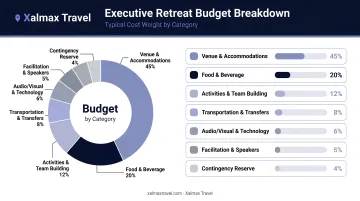
The CWT/GBTA 2025 Global Business Travel Forecast pegs average daily per-attendee meeting costs at $169 — but that's for general corporate events. Executive retreats at premium properties with dedicated facilitators and upgraded accommodations run significantly higher. Industry directional benchmarks suggest $300–$500 per person per day as a starting range, with high-end experiences exceeding that.
Budget clarity at this stage enables every downstream decision. Once you know what you can spend, confirming headcount becomes the next critical input.
Confirm the Guest List and Assign a Planning Owner
Group size determines venue type, breakout room requirements, and facilitator needs. Get this confirmed early:
- Will spouses or non-executives attend any portion of the retreat?
- Are there any attendees with specific accommodation requirements?
- Does the size require dedicated breakout rooms, or will one space work?
Assign one internal planning owner with actual decision-making authority. Retreats managed by committee consensus stall constantly — someone needs to be able to say yes or no without a chain of approvals on every vendor question.
60 Days Out: Source the Venue and Lock In Travel
This is when money starts moving — deposits get paid, cancellation windows open, and the cost of changing your mind rises with every week that passes. By the end of this phase, the venue should be signed and travel either centrally booked or covered by a policy with a firm deadline.
How to Choose an Executive Retreat Venue
Not all corporate venues work for executive retreats. The key criteria:
- Privacy — away from general hotel guests, ideally with a dedicated wing or property
- Meeting space — main room plus at least 2 breakout rooms for a group over 15
- AV and connectivity — confirm Wi-Fi bandwidth, screen quality, and hybrid video capability before sending an RFP
- Accommodation quality — befitting a C-suite group (single-occupancy rooms minimum)
- F&B flexibility — dietary accommodations, meal quality, and catering options
- Airport proximity — direct flight access matters for executives traveling from multiple cities
Request proposals from 2–3 venues and evaluate on total cost, not just room rate. Meeting room fees, F&B minimums, AV packages, resort fees, and service charges routinely add 30–40% to the advertised figure. Review cancellation and force majeure clauses before signing.
If venue research is consuming your schedule, Xalmax Travel's free venue sourcing service is worth using here. You submit your group size, budget, preferred city, and any special requirements — they surface shortlisted options from their global network of premium properties, then handle negotiations, contracts, and logistics. There's no cost to you; venues pay their commission directly.
Arrange Travel, Transfers, and Accommodations
Group travel decisions need to be made now, not at 30 days:
- Booking approach: Central booking (more control, easier tracking) vs. travel policy with a firm submission deadline — no later than 45 days out either way
- Airport transfers: Book shuttles or executive car service for arrival and departure windows; executives arriving at different times need a clear protocol
- On-site transportation: If the retreat involves off-property dinners or activities, ground transportation needs to be arranged in advance
- Rooming list: Start it now, even if incomplete. Note that nearly half of corporate event attendees now travel business class or above, and executives often expect direct flights and single-occupancy rooms as defaults
Get room assignments and any suite requests in writing early — these conversations get harder at 30 days.
30 Days Out: Finalize the Agenda and Communicate Everything
Logistics should be locked by now. The work shifts from booking to coordination — making sure every attendee and vendor has identical, accurate information.
Design an Agenda That Balances Strategy and Recovery
The most common executive retreat mistake: stacking the schedule with consecutive sessions until the group is cognitively depleted by day two. Microsoft's Human Factors Lab research shows back-to-back meetings cause cumulative beta wave stress buildup, with 10-minute breaks resetting stress levels and maintaining engagement across sessions.
A practical agenda framework:
- Cap strategic work blocks at 90 minutes; always break before the next intensive session
- Build in 10–15 minutes between sessions — treat these as non-negotiable
- Use lunch and dinner as social anchors, not working sessions for every slot
- Reserve at least one 60–90 minute window for unstructured conversation; relationships develop here, not in structured sessions
- Label evening activities as optional; some executives need downtime to process
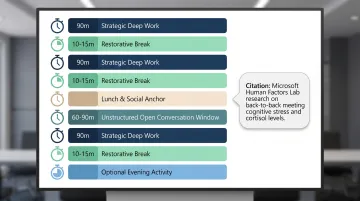
Share the agenda at least two weeks out. Include attire guidance, expectations, pre-work assignments, and a clear note on what's required vs. optional.
Confirm Speakers, Facilitators, and AV Needs
With the agenda distributed, confirm who's running each session — and whether the room setup and tech can support them.
External facilitators solve a structural problem in executive settings: when one internal leader runs the room, they can't also participate freely. A neutral third party lets every executive engage without someone splitting attention between facilitation and contribution.
The comparison is clear:
| Factor | External Facilitator | Internal Lead |
|---|---|---|
| Neutrality | No political position or relationship to protect | May manage dominant voices cautiously |
| Role conflict | Focused entirely on process | Splits attention between facilitation and participation |
| Power dynamics | Can challenge senior voices without consequence | May defer to rank |
Look for facilitators with experience specifically in executive team settings, familiarity with strategic planning methods, and ideally certification through the International Association of Facilitators.
On AV: confirm Wi-Fi bandwidth, screen setup, presentation compatibility, and hybrid video capability with the venue directly — not just on paper. Test everything before arrival day. Failed tech is one of the fastest ways to lose executive confidence in your planning.
Send One Clear Pre-Retreat Communication
Attendees should receive one comprehensive email — not a series of Slack messages or a folder of linked documents. That email must include:
- Confirmed dates and location with arrival instructions
- Travel details and deadlines
- Agenda outline
- What to pack and dress code
- Dietary and preference form deadline
- Emergency contact for day-of issues
If it's not in that email, don't assume people will find it elsewhere.
What to Actually Do at an Executive Retreat: Session Planning Guide
The logistics get executives in the room. The session design determines whether they leave with strategic clarity or politely enthusiastic confusion.
Three session types form the core of any well-designed executive retreat:
1. Strategic visioning sessions : Clarifying long-term direction and priorities. Best suited when the retreat objective is alignment on a multi-year growth strategy or a direction reset. These sessions work better as facilitated discussions than presentations.
2. Working sessions : Breakout groups tackling specific strategic challenges. Assign a clear question or problem statement in advance. The output should be a concrete recommendation or decision, not a list of considerations.
3. Relationship-building experiences : Structured or unstructured activities that develop trust among leaders who mostly interact transactionally. These don't need to be elaborate; a shared dinner with a loose conversation structure often works better than a formal team-building exercise.
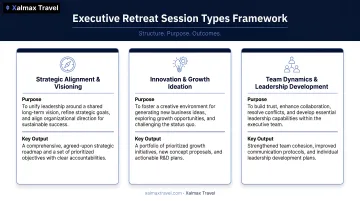
The ratio of these three types should reflect the retreat's defined objective. A culture reset needs more relationship-building time; a strategic planning retreat front-loads working sessions.
Strategic Planning Questions Worth Using
Well-designed questions, distributed in advance as pre-work, improve the quality of in-room discussion. McKinsey's framework for business unit strategic review provides a useful model:
- Where have our forecasts differed from actual outcomes, and what does that tell us about our assumptions?
- What trends in customer demand, technology, or regulation could change our strategic plan entirely?
- How is this strategy meaningfully different from our competitors' — and from our own plan last year?
- What are our genuine competitive strengths, and is our current plan actually built on them?
- What organizational capabilities do we need to execute this strategy that we don't currently have?
Distribute two or three of these as pre-work with a request for written responses.
Final Week Prep and Post-Retreat Follow-Up
Final Week Confirmation Checklist
- Reconfirm venue, catering, all vendors, and transportation with direct contacts (not just email threads)
- Send a final attendee briefing: arrival instructions, schedule, parking or transfer details, emergency contact
- Print or share a backup itinerary that doesn't require internet access
- Designate one on-site point person whose sole job is handling problems — this should not be the lead organizer, who needs to participate in the retreat itself
Post-Retreat: Where ROI Is Won or Lost
The retreat's value is determined by what happens in the 48 hours after it ends. Decisions that aren't documented within two days lose momentum fast — executives are back in their inboxes, and the clarity from the retreat fades quickly.
Before the end of day two:
- Survey attendees — five questions or fewer, sent within 48 hours. Small groups surveyed promptly hit 24–30% response rates; waiting even a few days cuts that number sharply.
- Circulate a decision and commitment summary — what was agreed, who owns each action item, and by when. Named owners only; no "the team will..." language.
- Review budget actuals against estimates — note the variances, file the rooming list, agenda, and vendor contacts for next time.
The next executive retreat should start from a documented baseline, not from scratch — that file you create today is the foundation for a smoother process next time.
Frequently Asked Questions
How much does a corporate retreat cost?
General corporate meetings average $169 per person per day according to the 2025 CWT/GBTA forecast, but executive retreats at premium properties run significantly higher. Industry directional estimates suggest $300–$500 per person per day as a starting range, with final costs driven by location, accommodation quality, facilitator fees, and group size.
What is a strategic planning retreat?
A strategic planning retreat is a dedicated offsite where senior leaders step away from daily operations to work on long-term direction, priorities, and resource allocation. Unlike team-building or celebration retreats, the primary output is strategic decisions and aligned priorities, not morale.
What should you do at a leadership retreat?
Plan for facilitated visioning sessions, working breakouts on specific business challenges, and relationship-building time. How you weight each depends on the retreat's stated objective, which should be locked in at the 90-day planning stage.
What should a strategy checklist include?
Key elements: a defined strategic objective, realistic per-person budget with contingency, confirmed venue, balanced agenda with mandatory breaks, pre-distributed pre-work materials, facilitator arrangements, and a post-retreat action plan with named owners and deadlines.
What are good strategic planning questions?
Strong questions push leaders to assess current performance honestly, identify competitive differentiation, surface capability gaps, and stress-test their assumptions. Distributing 2–3 questions as pre-work before the retreat significantly improves the quality of in-room discussion.
Can I write off a corporate retreat?
Business travel costs (airfare, lodging, ground transport) are generally 100% deductible if the trip is primarily for business; meals remain 50% deductible. Entertainment expenses are no longer deductible under the Tax Cuts and Jobs Act. Consult a tax professional, as IRS rules carry specific conditions and recordkeeping requirements.