The stakes are real. Remote and hybrid work have made team cohesion harder to maintain, and in-person offsites have become one of the few reliable ways to rebuild it. According to Harvard Business Review, remote and hybrid working has made it significantly harder for employees to foster meaningful connections with colleagues — which is precisely why a well-executed offsite carries so much weight right now.
This guide walks you through every stage: setting goals, building a purposeful agenda, choosing the right venue, avoiding common mistakes, and following through after the event. By the end, you'll have a clear roadmap instead of a blank page.
Key Takeaways
- Start planning 10–12 weeks out for groups of 20+; venue availability disappears faster than most planners expect
- Define your primary goal before touching logistics — strategy-focused and culture-focused offsites require different agendas
- Budget for venue, travel, food and beverage, facilitation, activities, and a contingency buffer from the start
- A distinctive venue signals this time is different; a hotel conference room signals another workday
- Follow up within 48–72 hours with decisions, action items, and owners — or the momentum evaporates
Why Team Offsites Are Worth the Investment
Before pitching an offsite budget to leadership, it helps to understand what the data actually says about in-person team investment.
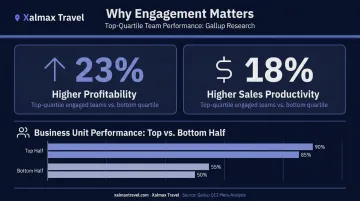
Gallup's Q12 Meta-Analysis found that business units in the top half on employee engagement more than doubled their odds of success compared to bottom-half units — with 23% higher profitability and 18% higher sales productivity among top-quartile teams. Engagement doesn't happen by accident. It's built through intentional investment in the people doing the work.
Offsites are one of the few settings where leaders can address two distinct needs simultaneously:
- The business — strategy, alignment, decisions, and operational priorities
- The company — the people, relationships, culture, and how the team actually functions together
Most meetings only touch the first. Offsites, done well, can address both.
Spending without a clear purpose is the real risk — not the budget itself. Offsites that energize teams share a few qualities: a defined goal, a clear agenda, and enough unstructured time for real conversation.
The ones that fall flat tend to have an overpacked schedule, vague objectives, and no breathing room beyond back-to-back presentations.
Step 1: Define Your Goals and Who Should Attend
Every logistics decision — venue size, agenda format, event duration — flows from one question: What is this offsite actually for?
Without a clear answer, every downstream decision — budget, format, guest list — becomes a guess.
Common Offsite Goals
Choose one primary goal. Mixing too many into a single event dilutes the impact of each.
- Strategic alignment — Reviewing direction, priorities, or annual plans as a leadership group
- Team relationship-building — Investing in connection after a period of remote work or rapid growth
- Post-reorg reset — Rebuilding trust and clarity after structural changes
- New initiative launch — Getting cross-functional buy-in on a major project or direction
- Performance recognition — Rewarding a team's results with an experience that signals appreciation
Once you've identified the goal, let it dictate the agenda format. A strategic alignment offsite looks very different from a relationship-building one — the former needs structured working sessions, the latter needs unstructured time built in.
Deciding Who Should Attend
Group scope affects everything: room size, facilitation approach, catering minimums, and breakout design.
Ask these questions before finalizing the list:
- Is this a whole-company event, a single team, or leadership only?
- Does the purpose require everyone present, or just decision-makers?
- Are there people who would benefit from attending but aren't obvious invitees?
Collect RSVPs at least 6–8 weeks before the event. Confirmed headcount drives venue minimums, catering orders, and breakout group structure — and venues often lock in room blocks well before the date.
Step 2: Set Your Budget and Start Planning Early
Building Your Budget
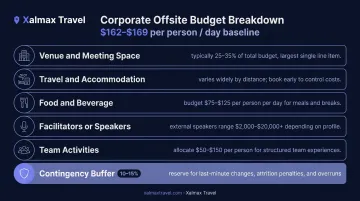
According to GBTA, the average daily cost per attendee for corporate meetings and events was projected at $162 in 2024, rising to approximately $169 in 2025. That's a useful baseline, but it covers meeting day costs only — not travel or accommodation.
Plan for these cost categories from the start:
| Category | Notes |
|---|---|
| Venue & meeting space | Room rental, AV, setup fees |
| Travel & accommodation | Flights averaging ~$705–$721; hotel ADR around $161–$163/night |
| Food & beverage | F&B costs rose 10%+ for 27% of planners in 2024 |
| Facilitators or speakers | Prioritize over venue upgrades when budget is tight |
| Team activities | Half-day experiences, dinners, team challenges |
| Contingency buffer | Budget for 10–15% above your estimate; offsite costs almost always run over |
Run a must-haves vs. nice-to-haves exercise early. If budget is tight, a simpler venue to afford a stronger facilitator is usually the smarter tradeoff.
Start Earlier Than Feels Necessary
For groups of 20 or more, begin planning at least 10–12 weeks out. Key milestones to hit in order:
- Goals defined and attendee list confirmed
- Budget approved
- Venue sourced and booked
- Agenda drafted and shared with stakeholders
- Pre-work distributed to attendees
- Travel logistics finalized
Slip on one early milestone and everything downstream compresses. Venue availability moves fast — especially at properties with in-demand amenities, outdoor spaces, or limited room blocks.
Step 3: Choose the Right Venue for Your Team Offsite
Venue choice has a disproportionate impact on how people show up — mentally and physically. A generic hotel conference room sends one signal: this is just another workday. A distinctive space, a property with natural light and outdoor access, or a setting that's visually removed from the office sends a different one: this time matters.
Research from HBR found natural light was the most appreciated workplace perk in a poll of 1,614 employees. That preference doesn't disappear at offsites.
What to Evaluate in a Venue
- Main room size — Can all attendees sit in a circle or U-shape? Auditorium rows discourage conversation
- Breakout spaces — You'll need them for small group sessions
- Natural light and outdoor access — Drives energy and engagement throughout the day
- On-site or nearby accommodation — Keeps the group together and reduces logistics friction
- Catering capabilities — In-house F&B simplifies coordination significantly
- AV setup — Confirm what's included vs. what's an add-on
Timing and Location
Avoid end-of-quarter crunch periods and major holiday windows — attendance suffers and minds wander. On location: choose somewhere that minimizes travel friction for the majority of attendees. "Fair to everyone" almost always outperforms "exciting to a few."
Getting Venue Sourcing Right
Once you know what you need in a venue, actually finding it is where the time goes. Sourcing involves hours of research, vendor outreach, rate comparisons, and contract review. According to GBTA, companies with a defined sourcing process for meeting space report average savings of 22% compared to those without one.
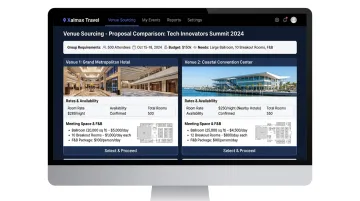
Xalmax Travel offers a free venue sourcing service that handles this entirely. You share your group size, budget, preferred city, and any special requirements. Their team searches a global network of premium hotels and venues — with particular focus on California and Colorado markets — and returns side-by-side proposals covering rates, availability, meeting space details, and total estimated cost.
The service includes negotiation and contract management: room rates, F&B minimums, attrition clauses, and cancellation terms. Hotels and venues pay the commission; there's no cost to the planner.
Step 4: Build a Purposeful Team Offsite Agenda
The most common agenda mistake is cramming too many topics into too little time. Doing less, more deeply, produces better outcomes. Two or three sessions that go somewhere meaningful beat six sessions that skim the surface.
Structuring the Day
If you have a full day or more, divide the agenda into two halves:
First half — Business topics:
- Strategy review or goal alignment
- Key decisions that need the full group
- Financial or operational updates
- Project or initiative planning
Second half — Company topics:
- How the team works together
- Communication norms or process gaps
- Culture, recognition, or team health
- Honest conversation about what's working and what isn't
Vary the Formats Throughout the Day
Different formats keep energy up and give different personality types a genuine way to contribute. Mix:
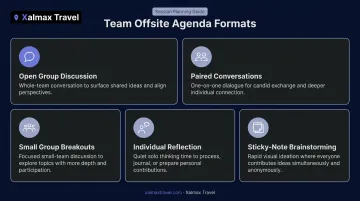
- Open group discussion — Good for decisions and alignment
- Paired conversations — Surface quieter voices and build one-on-one connection
- Small group breakouts — Ideal for generating ideas or working through specific problems
- Individual reflection or journaling — Slows the pace and improves quality of contribution
- Sticky-note brainstorming — Equalizes participation before discussion begins
The Opening and Closing Matter Most
The opening sets the tone for everything that follows. Leaders should open with a clear articulation of why this offsite is happening, what the team will accomplish together, and how it connects to the larger mission. Skip the logistics rundown — that can go in a pre-read.
The closing determines how people remember the event. End with structure: each person shares one insight and one commitment before leaving. This takes 15–20 minutes and meaningfully increases the chance that the energy from the day carries forward. Assign a designated note-taker for each session to capture decisions and action items in real time. Memory is unreliable under a full day of discussion.
Pacing matters, too. Microsoft's brain research found that short breaks between sessions allow stress levels to reset, improving focus and engagement in what follows. Build in a break after the first 90 minutes, then every two hours after that.
Step 5: Run It Well and Follow Through Afterward
Common Facilitation Mistakes
Even a well-planned offsite can fall flat in execution. Watch for these:
- Over-scheduling — Every agenda needs buffer time. Without it, the day runs late and the closing gets cut
- The leader trying to facilitate and participate simultaneously — These are incompatible roles. Hire or designate a neutral facilitator so the leader can be fully present
- Neglecting connection — Business outputs fill the agenda; team connection gets squeezed out.
For distributed teams traveling from afar, design space for human needs — time to check in on personal responsibilities, especially for anyone who's crossed time zones to get there.
After the Offsite
Send a follow-up within 48–72 hours covering:
- Key decisions made and the rationale behind them
- Action items, owners, and deadlines
- Any open questions that need resolution before the next touchpoint

HBR recommends assigning someone to track and follow up on action items, with an 85% completion rate as a practical benchmark. Without structured ownership, even the best offsite produces decisions that stall out before the next team meeting.
Alongside that follow-up, send a short post-event survey within a day or two while the experience is fresh. Ask whether attendees feel more aligned, more connected, and clearer on priorities than before the event. Use the responses to measure against your original goals — and to plan the next one smarter.
Frequently Asked Questions
How do you structure a team offsite?
Start with a clear opening that sets context and expectations, then divide the main sessions between strategic/business topics and team/people topics. End with a structured closing where attendees share one insight and one commitment, capturing action items before anyone leaves.
How far in advance should you plan a team offsite?
For groups of 20 or more, start at least 10–12 weeks out. Key milestones — goal-setting, venue booking, agenda drafting, pre-work distribution, and travel arrangements — all compress painfully when planning starts late.
How long should a team offsite be?
One to two full days is the most common length. One day works well for focused goal-setting or alignment sessions. Two days allows time to combine strategic work with deeper team connection, which is harder to achieve in a single day.
What should a team offsite agenda include?
A purposeful opening, a mix of strategic working sessions and team connection activities, built-in breaks every 90 minutes to two hours, and a structured closing with clear action items and named owners for each.
How much does a team offsite cost per person?
GBTA benchmarks put the average daily meeting cost at roughly $162–$169 per attendee, not including travel or overnight accommodation. Hotel rates average around $161–$163 per night, and airfare averages $705–$721.
How do you measure whether a team offsite was successful?
Measure against the goals you set before the event. Post-event surveys are the most practical tool : ask whether attendees feel more aligned, more connected, or clearer on priorities.