This guide is written for sales managers, administrative assistants, and corporate event planners who own those behind-the-scenes decisions. It covers a phase-by-phase logistics framework, vendor and budget best practices, and the most preventable mistakes that derail otherwise well-planned events.
Key Takeaways
- Corporate event logistics = end-to-end coordination of venue, vendors, technology, staffing, transport, and team communication
- Start planning 6–12 months out for large events; define objectives before any logistics decisions
- Build a 10–15% contingency fund and assign dedicated roles for each logistics category
- The costliest mistakes are budget overruns, tech failures, understaffing, and fragmented communication
- Post-event surveys should go out within 48 hours — that feedback drives direct improvements to your next event
What Corporate Event Logistics Actually Covers
Corporate event logistics is the end-to-end coordination of every operational element required to plan and execute a corporate event. That includes venue sourcing, transportation, AV and tech, catering, staffing, attendee communication, and teardown — all working together to deliver an experience that reflects the organization's professionalism.
The stakes are real. According to Cvent's 2026 event statistics report, 26% of planners said a poor attendee experience would deter them from returning to a venue — and that perception extends to the event host, not just the space. Poor logistics don't just disrupt a single day; they damage relationships and erode confidence in whoever organized the event.
The financial scale puts this in sharper focus:
- The global corporate events market was valued at $325 billion in 2023, projected to approach $600 billion by 2029
- Yet 41% of marketers struggle to measure event ROI, per the same Cvent data — meaning most organizations spend heavily without a reliable feedback loop
Spending more doesn't automatically produce better outcomes. What does? A planning infrastructure tight enough that every moving part — vendors, timelines, attendee touchpoints — is accounted for before the first guest arrives.
Pre-Event Planning: Building Your Logistics Foundation
Define Objectives First, Then Build Your Timeline
Every logistics decision traces back to the event's primary objective. A networking retreat needs open social spaces and flexible room configurations. A product launch requires flawless AV and controlled guest flow. A President's Club incentive trip demands a venue that signals exclusivity. Starting without defined objectives leads to misaligned spending and confused vendors.
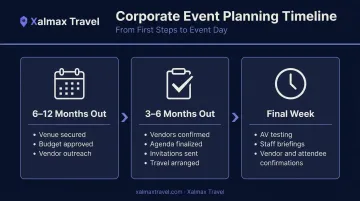
Once objectives are locked, map out a phased timeline:
- 6–12 months out: Secure venue, get budget approved, begin vendor outreach
- 3–6 months out: Confirm vendors, finalize agenda, send invitations, arrange travel and accommodations
- Final week: AV testing, staff briefings, confirm all logistics with vendors and attendees
Skift Meetings research found 75% of business-event planners said events were being organized with shorter lead times than pre-pandemic. Compressed timelines are common, but they increase risk — particularly for venue availability and vendor contracts.
Venue Sourcing and Contracting
Venue selection sets every other logistics constraint. The key evaluation criteria:
- Capacity — does it accommodate your headcount with room to breathe?
- Breakout space — enough separate rooms for parallel sessions?
- AV and Wi-Fi: built-in infrastructure, or will you need an external vendor?
- Location — proximity to airports and lodging options
- Catering policy: in-house only, or can you bring outside vendors?
- Contract terms — cancellation windows, attrition clauses, F&B minimums
Venue research and RFP outreach is one of the most time-consuming steps in the entire planning process. Xalmax Travel eliminates that burden — their free venue sourcing service delivers tailored options matched to your budget, group size, and event type. Submit your meeting city, attendee count, and key requirements, and their team handles outreach, proposals, and contract negotiation, including attrition penalties, cancellation clauses, F&B minimums, and force majeure terms. The service costs nothing to corporate clients; hotels and venues pay the commission.
Read every contract carefully before signing. Confirm exactly what's included in the room rate (AV, Wi-Fi, parking), and make sure cancellation and attrition consequences are clearly defined upfront. Attrition penalties can be calculated per-night rather than cumulatively, meaning partial pickup can still trigger significant charges.
Staff and Vendor Onboarding
With the venue locked and contracts reviewed, the next step is making sure your team and vendors are equally prepared. Assign ownership to each logistics category before planning advances:
- Registration and check-in
- AV and tech support
- Catering coordination
- Guest transportation
- On-site operations lead
Cross-train at least one backup for each critical role. Day-of coverage gaps are avoidable when preparation happens weeks in advance.
Confirm all vendor agreements in writing — including delivery windows, setup responsibilities, contingency protocols, and escalation contacts. Verbal confirmations are not sufficient at this scale.
On-the-Day Execution: Managing Every Moving Part
Final Walk-Through and Setup
Complete a full venue walk-through at least 2 hours before doors open. Cover:
- Verify all vendor setups match contracted specifications
- Test all AV equipment, microphones, and Wi-Fi connectivity
- Confirm signage placement and directional flow
- Check food and beverage staging areas
- Review the run-of-show document with all department leads
Problems caught during the walk-through take minutes to fix. The same problems discovered after guests arrive take much longer — and they're the first thing attendees notice.
Guest Flow and Check-In
Bottlenecks at registration set the tone for the entire event. Prevent them with:
- Multiple check-in stations scaled to expected arrival volume (don't optimize for average, optimize for the arrival surge)
- Digital check-in tools or pre-printed badge systems
- Clear directional signage to breakout rooms, restrooms, and amenities
- Separate VIP and speaker staging that doesn't intersect with the main registration queue
Real-Time Problem Solving
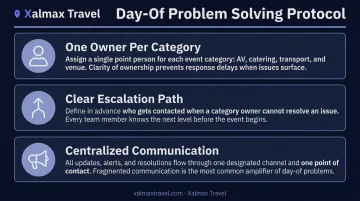
Establish a troubleshooting team with clear decision-making authority before the event starts. Structure your response protocol around three principles:
- One owner per category: Tech, catering, and transport each get a single designated point of contact — no ambiguity about who can authorize a fix
- Clear escalation path: Minor issues stay with the category lead; anything that affects the run-of-show goes to the event director immediately
- Centralized communication: Use one shared channel — group messaging app, walkie-talkies, or event management software — so all staff receive updates simultaneously, not in fragmented chains
Vendor Coordination and Budget Management
Structuring Vendor Agreements
Well-written contracts prevent most day-of surprises. Every vendor agreement should specify:
- Exact delivery times and setup windows
- Specific deliverables (quantities, configurations, formats)
- Contingency protocols if something goes wrong
- Escalation contact for the vendor organization
Schedule check-in calls as the event date approaches — don't assume silence means everything is on track.
That communication discipline also reveals where you're exposed. Always identify a backup vendor for high-impact services — catering and AV are the two categories where a single-vendor failure can collapse the entire event schedule.
Consider what a vendor chain reaction looks like. A catering delivery runs 45 minutes late. That delays lunch service, compresses the afternoon agenda, and pushes the event past the venue's contracted end time — triggering overtime fees. None of those downstream costs appear in the original contract. They're created by one delayed delivery that no one escalated.
Building a Sound Budget
Structure your budget around these categories:
| Category | Common Cost Drivers |
|---|---|
| Venue | Room rental, overtime fees, setup/teardown |
| Food & Beverage | Per-person minimums, service charges, gratuity |
| AV / Tech | Equipment rental, technician labor, backup gear |
| Staffing | Event staff, temp labor, overtime |
| Transportation | Ground transfers, shuttle service |
| Materials | Printed collateral, signage, branded items |
| Contingency | 10–15% of total budget |
The contingency line is non-negotiable. According to MPI's planning guidance, planners should budget 10–15% for unexpected costs. Require formal sign-off for any unplanned expenditure above a pre-agreed threshold, and track line items in real time — not just at final reconciliation.
Cost pressure is genuine across the industry. Cvent data shows 69% of planners reported F&B costs higher than expected, and 63% cited accommodation rates as a challenge. Build those known risk categories into your initial projections — not as afterthoughts during final reconciliation.
Common Corporate Event Logistics Mistakes
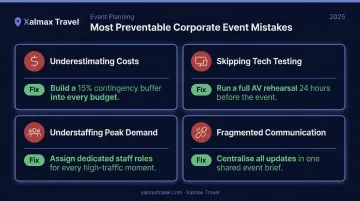
Four mistakes derail more corporate events than any venue or catering issue. Recognize them early — they're all preventable.
Underestimating costs and scope creep. The most common budget problem isn't one large unplanned expense — it's a series of small approved additions that compound. Fix: lock a contingency buffer and require formal approval for any change above your threshold.
Skipping technology testing. AV failures and Wi-Fi outages are almost always preventable. All technology — including backup equipment — must be tested on-site before event day, not on the morning of. Fix: assign a tech-specific staff lead who is present from setup through close.
Understaffing for peak demand. Planners frequently calculate staffing for average demand rather than peak moments: registration opening, the lunch rush, session transitions. Skift Meetings found that 48% of respondents had difficulty securing day-of event staff — a known industry challenge, not an edge case. Fix: staff generously for high-demand windows, assign break coverage, and keep two backup staff on standby call.
Fragmented attendee and staff communication. When last-minute changes occur — room reassignments, schedule shifts, transport delays — inconsistent communication creates confusion fast. Fix: designate one person responsible for all real-time updates, using a single channel, so everyone receives the same information at the same time.
Post-Event Logistics: Closing the Loop
Teardown and wrap-up deserve the same planning discipline as setup. Assign staff to manage each close-out task before anyone leaves:
- Oversee equipment dismantling and removal
- Confirm return or storage of all rented items
- Settle outstanding vendor invoices on-site where possible
- Complete a final venue walkthrough and document the space's condition
The post-event phase is where logistics actually improve over time. PCMA recommends sending attendee surveys within 48 hours of the event concluding, while impressions are still fresh. Keep the survey open no longer than two weeks and follow up with no more than two reminders.
Conduct a debrief with all logistics leads to document what worked and what failed. That debrief feeds directly into a post-event report covering:
- Budget actuals vs. estimates
- Vendor performance notes
- Attendee feedback summary
- Recommendations for next time
This document becomes the planning baseline for every event that follows. Teams that build this habit consistently find that each event requires less reactive problem-solving than the last.
Frequently Asked Questions
What are the key principles of corporate event logistics planning?
Start early with clearly defined objectives, coordinate all vendors through written agreements, and build contingency plans into every phase. Communication needs designated owners for every category — treat it as a core logistics function, not a secondary task.
How much do corporate event planners charge?
Corporate event planners typically charge a flat project fee, a percentage of the total event budget (commonly 10–20%), or an hourly rate. The Bureau of Labor Statistics reports a median hourly rate of $28.58; Glassdoor shows a broader range averaging around $40/hour for corporate specialists. Note that some venue sourcing services operate on a commission-based model, making them free to the client.
How far in advance should you start planning corporate event logistics?
Large events with 150+ attendees typically require 6–12 months of lead time. Smaller meetings or retreats need a minimum of 8–12 weeks. Venue availability and vendor booking windows are usually the first constraints that force the timeline.
What should a corporate event logistics checklist include?
Essential categories include:
- Venue contract and setup details
- AV and tech requirements
- Catering and dietary accommodations
- Transportation and lodging for attendees
- Staffing assignments, attendee communication plan, and post-event teardown steps
How do you handle last-minute changes during a corporate event?
Have a designated on-site decision-maker with authority to approve changes without escalation delays, and pre-build contingency plans for the most likely scenarios — speaker cancellation, AV failure, weather disruption. Push all updates through one centralized channel so every staff member gets the same information simultaneously.