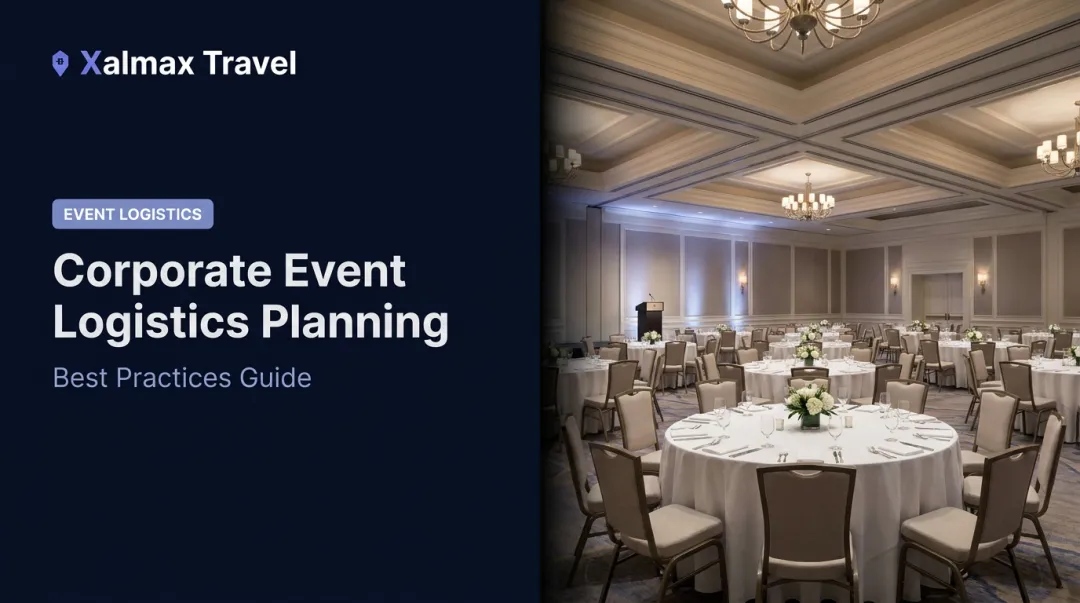
This guide walks through the full corporate event planning process: defining goals, building a realistic budget, selecting the right venue, coordinating vendors, and executing on the day. Whether you're a dedicated event planner or an administrative assistant managing this alongside a full workload, you'll find a practical framework here.
Key Takeaways
- Clear goals and a locked budget come before any vendor conversation
- Venue selection drives nearly every other decision — and takes more time than most planners expect
- The 5 C's framework — Concept, Coordination, Control, Culmination, Closeout — works for events of any size
- Start planning 6–12 months out for large conferences; 3–6 months for mid-size events
- Venue sourcing services like Xalmax Travel handle research and vendor outreach for free — funded by the venues, not you
What Is Corporate Event Planning?
Corporate event planning is the process of organizing professional gatherings that serve a defined business objective — aligning teams, rewarding top performers, engaging clients, or launching a product. Unlike social event planning, every corporate event has a business case behind it. Budgets require justification, outcomes get measured, and stakeholders expect a return.
Responsibility for corporate events varies by company:
- Dedicated event planners at larger organizations with frequent event calendars
- Administrative assistants and executive assistants who manage events alongside other responsibilities
- Sales managers coordinating kickoffs, President's Club trips, or client events
- Outsourced event management companies brought in for complex, large-scale events
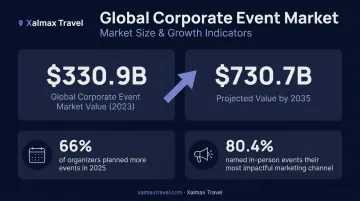
The market behind these gatherings is substantial. According to Allied Market Research, the global corporate event market was valued at $330.9 billion in 2023 and is projected to reach $730.7 billion by 2035 — a 7% compound annual growth rate. Bizzabo's 2025 B2B benchmark found 66% of organizers planned to schedule more events in 2025 than in 2024, and 80.4% named in-person events their most impactful marketing channel. The numbers confirm what most planners already know: corporate events aren't a line item to trim — they're a core business tool.
Types of Corporate Events
Internal Events
Internal events focus on alignment, culture, and performance. Common formats include:
- Town halls and all-hands meetings — company-wide communication and leadership visibility
- Sales kickoffs — annual or quarterly sessions to align revenue teams on goals and strategy
- Team-building retreats — structured experiences designed to strengthen collaboration and morale
- Executive retreats — strategic planning sessions for leadership in focused, off-site environments
- Employee appreciation events — recognition programs that reinforce culture and retention
- Training and development sessions — skill-building workshops or certification programs
External Events
External events build brand visibility, generate leads, and deepen client relationships:
- Product launches — introducing new offerings to media, partners, or customers
- Client appreciation dinners — relationship-building in a hospitality setting
- Trade shows and conferences — industry presence and lead generation at scale
- Networking events — curated connections between prospects, clients, and partners
Hybrid and Virtual Formats
Both internal and external events increasingly run in hybrid or fully virtual formats — and the numbers back that up. Bizzabo's 2025 research found 53% of attendees planned to attend more webinars in 2025, alongside the 54% who planned to attend more in-person events — these formats run in parallel, not competition.
Planning for hybrid and virtual looks different from in-person from the start:
- AV and streaming infrastructure move to the center of the budget conversation
- Digital engagement tools replace physical networking
- Attendee experience must be designed separately for two audiences at once
Step-by-Step Corporate Event Planning Process
Step 1: Define Goals and Success Metrics
Every planning decision — budget, venue, format, date — should trace back to a stated objective. A sales kickoff optimizing for team alignment needs different logistics than a client conference designed for lead generation.
Define your goal in one sentence, then identify 2–3 measurable outcomes: attendance rate, satisfaction score, pipeline influenced, or deals closed post-event. These metrics anchor your budget conversations and give you something concrete to report back to stakeholders.
Step 2: Set a Budget and Secure Approval
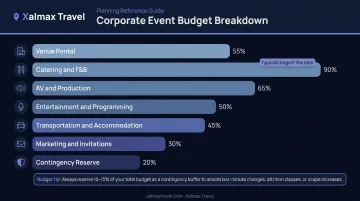
Build your budget across these core categories before approaching any vendor:
- Venue rental
- Catering and F&B (typically the largest single line item)
- AV and production
- Entertainment and programming
- Transportation and accommodation
- Marketing and invitations
- Contingency reserve
Get stakeholder sign-off on the total budget before outreach begins. Once vendors are in conversation, scope creep (a photo booth added here, a menu upgrade there) becomes much harder to control.
Budget pressure is real right now. PCMA's 2024 survey found 47% of planners expected budget increases averaging 15%, while AV and F&B costs continue to take the biggest share of event spend.
Step 3: Choose Your Format and Date
Match your format to your audience, goals, and budget:
- In-person: Highest engagement and networking value; highest cost
- Virtual: Lower cost and broader geographic reach; requires strong programming to hold attention
- Hybrid: Maximum flexibility; requires double the AV investment and careful experience design
On date selection, check for conflicts with major holidays, industry conferences, and internal company calendars. Large conferences need 6–12 months of lead time; mid-size events work with 3–6 months; small internal meetings can come together in 4–8 weeks, though venue availability may constrain even those.
Step 4: Source and Confirm Your Venue
Venue choice drives downstream decisions on catering, AV, accommodation, and transportation. Key evaluation criteria:
- Capacity and room configurations for your agenda format
- Location and accessibility for the majority of attendees
- In-house catering and AV (bundling reduces cost and coordination complexity)
- Accommodation availability for multi-day events
- Parking and ground transportation access
- Contract transparency — watch for F&B minimums, attrition clauses, and service fee structures
This step consistently takes longer than planners expect — build extra time into your timeline, and treat venue confirmation as a hard prerequisite before locking any other vendor commitments.
Step 5: Coordinate Vendors and Build a Run-of-Show
Your vendor ecosystem typically includes:
- Caterers
- AV and production teams
- Entertainment
- Photographers or videographers
- Transportation providers
Confirm all vendor contracts well before the event date, with deposits paid and deliverables clearly documented.
The run-of-show is non-negotiable: a minute-by-minute schedule shared with every vendor and internal stakeholder. It covers setup timelines, speaker order, AV cues, meal service windows, and breakdown. Distribute it at least one week out so vendors have time to flag conflicts before they become day-of problems.
Step 6: Communicate with Attendees and Capture Feedback
Pre-event communications should include:
- Save-the-date (as early as possible)
- Formal invitation with agenda, logistics, and registration link
- Reminder communications closer to the date with any updated details
Post-event, send a short survey within 48 hours. Satisfaction scores, net promoter data, and open-ended comments give you evidence to report ROI to stakeholders — and real input to improve the next event.
How to Budget for a Corporate Event
Budgeting is where many first-time corporate event planners underestimate their exposure. A few recurring traps:
- Catering surprises: Per-person F&B costs are rising. Skift Meetings reported the cost per meeting attendee per day was expected to reach $169 in 2025, up 4.3% year-over-year. Multiply that across a two-day event and a 100-person attendance and the number compounds quickly.
- AV upgrades: Basic in-house AV rarely covers a polished general session. Upgrades — screens, lighting, live streaming, microphones — stack up quickly and are often quoted separately.
- Service fees and gratuities: Venue contracts frequently add 20–25% in service charges on top of quoted F&B rates. These are not optional and are easy to overlook in initial comparisons.
- Missing contingency: Build a buffer into your budget from the start. Unexpected costs appear on almost every event.
Once you know where the traps are, you can build a smarter plan from the start.
Cost-Saving Strategies
- Book venues during off-peak periods (mid-week, January–February, or Q3 for many markets)
- Bundle catering and AV through the venue when possible — this simplifies negotiation and often reduces total cost
- Negotiate multi-event agreements with preferred vendors if your company runs several events annually
- Leverage hotel loyalty and rewards programs when booking sleeping room blocks
In-House vs. External Planning
Managing an event in-house keeps direct control but pulls heavily on staff who already carry full workloads. External event management companies typically charge in one of three structures:
- Flat fee: Fixed cost regardless of event size
- Percentage of budget: Usually 10–15% of total event spend
- Day rate: Billed per planner day for defined scope
The right model depends on event complexity and your team's internal capacity. One cost-often overlooked option: venue sourcing services like Xalmax Travel operate on a commission-paid model, meaning the service is free to the client — a practical starting point for companies trying to reduce planning overhead without adding line items to the budget.
How to Find and Book the Right Venue
Venue sourcing is consistently one of the most time-consuming steps in corporate event planning. Cvent's 2026 venue sourcing research found that 58% of planners spend up to five hours using technology to source each event — and that's before site visits, RFP follow-ups, and contract negotiations begin.
The traditional process looks like this: manual research across directories and hotel websites, cold outreach to venue sales teams, waiting on RFP responses, comparing proposals with inconsistent formatting, scheduling site visits, and then negotiating contracts — all while managing the rest of the event.
For a sales manager or administrative assistant running this process alongside a full workload, those hours add up quickly.
What to Evaluate When Comparing Venues
| Factor | What to Check |
|---|---|
| Location | Accessible for the majority of attendees; proximity to airport or transit |
| Capacity | Can accommodate your headcount with the right room layout |
| In-house services | On-site catering and AV reduces coordination complexity |
| Accommodation | On-site sleeping rooms for multi-day events |
| Contract terms | F&B minimums, attrition clauses, cancellation policy |
| Cost transparency | All-in pricing vs. quoted rate — look for hidden fees |
How a Venue Sourcing Partner Can Handle This for You
Xalmax Travel is a specialized venue sourcing service that handles the full process at no cost to the corporate client. Hotels and venues pay the commission directly, so there's no fee on your end.
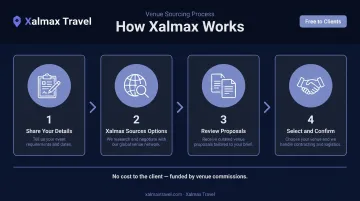
The process works in four steps:
- Share your details — budget, headcount, preferred city, and any specific requirements
- Xalmax sources options — their team searches a global network of premium hotels and venues to find properties that fit your specs
- Review proposals — you receive decision-ready documents comparing multiple venues side by side with negotiated rates, room configurations, amenities, and total estimated cost
- Select and confirm — Xalmax handles all negotiations, contracts, and logistics, including reviewing attrition, cancellation, and force majeure clauses to reduce financial risk
This works well for sales managers and executive assistants who need professional results without turning venue sourcing into a second job. Xalmax operates globally, with dedicated market depth in California (Los Angeles, San Francisco, San Diego, Napa, Palm Springs) and Colorado (Denver, Aspen, Vail, Boulder, Breckenridge).
You can reach their team at customerservice@xalmax.com or 347-688-2572.
The 5 C's of Corporate Event Planning
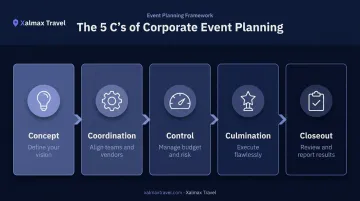
The 5 C's is a practical planning framework commonly used by event professionals to structure any corporate event from start to finish:
- Concept: Define the event's purpose, audience, format, and overall vision before any logistics work begins
- Coordination: Manage vendors, timelines, and stakeholder communications throughout the planning phase
- Control: Monitor budgets and risk factors as the event approaches — adjust as conditions change
- Culmination: Execute the event with all vendors aligned to the run-of-show
- Closeout: Debrief, collect attendee feedback, reconcile the budget, and document what worked
Each phase builds on the last. Skipping Concept and jumping straight to Coordination leads to misaligned expectations — planners book venues before the format is confirmed, or caterers are engaged before headcount is finalized. Neglecting Closeout means losing post-event data that justifies the budget and informs the next event.
That sequencing holds regardless of event size. Whether you're running a 20-person executive offsite or a 500-person annual conference, the same five phases apply.
Frequently Asked Questions
How much do corporate event planning companies charge?
Event planning companies typically use one of three fee structures: a flat project fee, a percentage of the total event budget, or a day rate. The right model depends on event scope and complexity. For straightforward venue sourcing specifically, services like Xalmax Travel charge nothing — the service is funded entirely by venue commissions.
What is the average cost per person for a corporate event?
Per-person costs vary by event type, duration, location, and service level. The most current industry benchmark from Skift Meetings puts the average meeting cost at $169 per attendee per day in 2025. A two-day event with meals, AV, and venue rental compounds that figure significantly.
Who plans events for corporations?
Corporate events are typically planned through one of three models:
- In-house: Internal event planners or administrative staff manage everything
- Outsourced: A full-service event management company takes the lead
- Hybrid: Internal teams own strategy while specialists handle venue sourcing, production, or logistics
What are the 5 C's of event planning?
The 5 C's are Concept, Coordination, Control, Culmination, and Closeout: a phased approach covering everything from initial planning through post-event wrap-up. See the dedicated section above for a full breakdown of each phase.
How far in advance should you plan a corporate event?
Large conferences typically require 6–12 months of planning time. Mid-size events work with 3–6 months. Small internal meetings can come together in 4–8 weeks, though venue availability often becomes the binding constraint. In practice, popular venues book out fast — especially in Q4 and early Q1 — so locking in your space first gives every other planning decision a fixed foundation.