Introduction
Planning a corporate conference while managing your regular workload is genuinely difficult. You're coordinating vendors, managing stakeholder expectations, tracking a budget that keeps shifting, and trying to hold together an agenda that actually serves a business purpose — often with no formal event planning background.
The scale of that challenge has grown. According to Cvent's 2025 sourcing report, 70% of planners expect live meeting volume to increase by up to 20% in 2026, and the U.S. corporate event services market is projected to reach $57.86 billion by 2035. More events, higher attendee expectations, and tighter budgets are converging at the same time.
This guide covers what you need to plan and execute a corporate conference without the surprises:
- What corporate conference management actually involves
- A step-by-step planning process from kickoff to debrief
- How to build a budget that accounts for what venues don't tell you upfront
- How to choose a venue that won't create problems the day of the event
Key Takeaways
- Define clear objectives before booking anything — vague goals lead to unfocused agendas and wasted spend
- Venue and F&B typically consume 65% of your budget; set your venue budget first, then build in a 10–15% contingency for overruns
- Venue selection shapes every other variable — evaluate infrastructure and contracts, not just aesthetics
- Post-event follow-up within 48 hours increases attendee purchase intent by 45%
What Is Corporate Conference Management?
Corporate conference management is the full process of planning, coordinating, and executing business gatherings — from initial goal-setting through post-event analysis. In 2026, that process is more complex than it was five years ago. 80% of planners now treat hybrid events as a permanent operational model, return-to-office momentum has revived demand for in-person gatherings, and attendee expectations for personalization have risen sharply across both formats.
Common Conference Formats
Each type demands a different planning approach:
- Annual all-hands meetings — large, logistically complex, agenda-heavy
- Leadership summits — smaller, high-stakes, confidentiality-sensitive
- Sales kickoffs — energy-driven, often multi-day with entertainment components
- Training workshops — require breakout rooms, hands-on materials, facilitators
- Product launches — AV-intensive, media considerations, external audiences
- Hybrid/virtual conferences — demand broadcast-capable infrastructure and separate virtual engagement planning
Outsourcing vs. In-House Planning
Three models are in common use:
| Model | Best For | Trade-Off |
|---|---|---|
| Fully in-house | Small events, tight budget, experienced team | Time-intensive, limited vendor leverage |
| Hybrid (in-house + specialist vendors) | Mid-size events with specific technical needs | Coordination overhead |
| Full third-party outsourcing | Large or complex programs, limited internal capacity | Higher cost, requires clear briefing |
The right model depends on three factors: team capacity, event complexity, and budget. Most sales managers and administrative assistants running events without dedicated planning staff fall somewhere between the first and second model.
The 5 C's of Corporate Conference Management
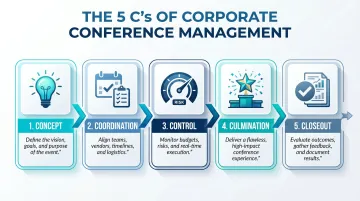
Professional conference planners use the 5 C's framework to structure their approach across every phase of an event. For internal teams managing a conference without deep planning experience, it functions as a useful checkpoint system — preventing the kind of scope creep and last-minute surprises that derail otherwise well-intentioned events.
The Framework
- Concept: Define the purpose, format, audience, and desired outcomes before any logistics are touched. Every downstream decision depends on clarity here.
- Coordination: Assemble suppliers, confirm vendors, build timelines, and align internal stakeholders. This is where most planning work actually lives.
- Control: Monitor execution against plan, track the budget in real time, and manage changes as they arise. Strong planners have contingency responses ready before they're needed.
- Culmination: The event itself. By this stage, execution depends almost entirely on how well the previous three phases were handled.
- Closeout: Post-event surveys, attendee follow-up, financial reconciliation, and a documented record of what worked and what didn't. Of all five phases, this one receives the least investment — and suffers the most for it.
Before signing a venue contract, confirming a keynote, or finalizing catering — run through the 5 C's as a quick checklist. Closeout is the phase most teams skip during planning; build time for it now, before the event calendar fills up.
The sections that follow apply this framework to each stage of your conference, starting with where most events are won or lost: the planning phase.
The Conference Planning Process: Step by Step
Step 1: Define Objectives and Success Metrics
Every planning decision should flow from a clearly defined goal. Without one, agenda sessions become filler, budget gets allocated by habit instead of purpose, and it's impossible to evaluate whether the event worked.
Vague objective: "We want to get the team aligned for the year ahead."
Well-defined objective: "By the end of the sales kickoff, every rep will have completed quota training, understand Q1 priorities, and leave with three booked prospecting sessions on their calendar."
The second version tells you what sessions to schedule, how to measure success, and what follow-up looks like. Define your version before opening a venue search.
Step 2: Assemble Your Planning Team and Timeline
Core roles for any corporate conference:
- Project lead — owns the master timeline and escalation decisions
- Logistics coordinator — manages vendor relationships, AV, and F&B
- Communications lead — handles attendee outreach and agenda distribution
- AV point-of-contact — liaises between the venue tech team and session needs
Timeline guidance:
- Under 250 attendees: begin planning 6 months out
- 250+ attendees or multi-day programs: 9–12 months
Starting later compresses your negotiating leverage and limits venue availability — premium venues book out fast, and late starts cost you options and rate flexibility.
Step 3: Design the Agenda with Attention in Mind
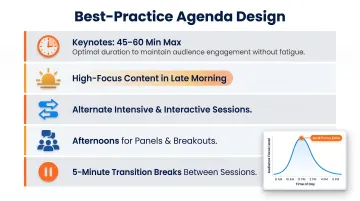
With your team locked in, the agenda is the next critical output. Research shows adults can sustain focused attention for approximately 20 minutes before needing a cognitive reset. Agendas that ignore this tend to fill days with 90-minute keynotes and wonder why energy collapses after lunch.
Practical agenda principles:
- Keep keynote sessions to 45–60 minutes maximum; aim for 20-minute blocks where possible
- Schedule high-focus content — training, strategic presentations, decision-making sessions — in late morning when attention is strongest
- Alternate cognitive-intensive sessions with interactive formats: workshops, small-group discussions, structured Q&A
- Reserve afternoon slots for panels, breakouts, and collaborative activities rather than lecture-style presentations
- Build in 5-minute transitions between sessions as attention-reset breaks, not just scheduling padding
Step 4: Lock Down Pre-Event Logistics
Once the agenda is set, logistics execution becomes the priority. Three to four weeks out, these items must be confirmed:
- AV/technology dry-run with all speakers and production staff
- Dietary and accessibility accommodations collected and confirmed with catering
- Attendee communications sent: save-the-date (6–8 weeks out), agenda preview (2–3 weeks), final logistics reminder (5–7 days)
- Contingency plans documented for speaker no-shows, AV failures, and weather-related travel disruptions
The dry-run is non-negotiable. More conferences are derailed by avoidable tech failures than by any other single factor.
Step 5: Post-Event Follow-Through and ROI Measurement
Logistics wrapped means the event is done — but the planning process isn't. Receiving follow-up communications increases attendee purchase intent by 45%, according to Spiro research cited via Cvent. That window closes quickly. Follow-up should go out within 48 hours.
Post-event priorities:
- Send surveys that measure against your Step 1 objectives — whether attendees can apply what they learned and whether goals were met, not just whether the food was good
- Capture action items with named owners before anyone leaves. Unassigned items are intentions, not commitments
- Build an ROI summary for leadership that maps outcomes directly against the objectives you set in Step 1
Only 76% of event teams use post-event surveys (ICE Benchmarking Report), meaning a significant portion collect no formal feedback at all. The data you gather here also informs next year's planning.
How to Build a Realistic Conference Budget
Budget Allocation Framework
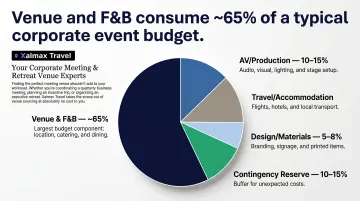
Start with this benchmark: venue and F&B combined consume approximately 65% of a typical corporate event budget (Booking.com for Business, 2026). Build from there.
| Category | Approximate Share | Notes |
|---|---|---|
| Venue + F&B | ~65% | Largest line item; negotiate hard here |
| AV/production | 10–15% | Cited by 66% of planners as major expense |
| Travel/accommodation | Varies | Can dwarf other costs for multi-city events |
| Design/materials | 5–8% | Often cut first; don't eliminate entirely |
| Contingency | 10–15% | Reserve this — costs almost always exceed projections |
Hidden Costs That Inflate Budgets
65% of event planners experience budget overruns, with an average overspend of 20%. A separate analysis puts the gap between planned and actual costs at 27–28% industry-wide. Watch for:
- Service charges of 22–25% added on top of F&B minimums — a $50,000 catering budget can balloon significantly before you factor in local taxes
- Exclusive vendor mandates requiring use of in-house AV or catering at marked-up rates
- Attrition fees if room block pickup falls short of contracted minimums
- Wi-Fi upgrade charges when venue bandwidth proves insufficient under load
- Overtime costs for venue staff and technical teams when events run long
Cost Reduction Strategies
- Negotiate complimentary meeting room access in exchange for room block commitments
- Cut AV costs by bundling it into the hotel package rather than contracting separately
- Consider secondary-city locations — comparable venue quality at noticeably lower rates than Tier 1 markets
- Build multi-year venue relationships to negotiate better attrition terms and rate protection
Contingency Buffer
Industry guidance from Momentive Software recommends at least 5% of total budget for contingency, with experienced planners preferring 10–15% for complex or multi-day events. Given that most events exceed their original budgets by 20% or more, this reserve is what keeps a cost spike from derailing the entire event.
How to Choose the Right Conference Venue
Venue selection is the most consequential single planning decision you'll make. The physical space determines agenda flow, AV capability, catering quality, attendee accessibility, and the overall tone of the event. Choose based on verified performance, not marketing materials.
Infrastructure Criteria
During a site visit, evaluate these infrastructure factors:
- Wi-Fi bandwidth tested under load — standard corporate conferences require 2–3 Mbps per user; add 40% headroom for device surges (attendees carry 1.8–2.0 devices each)
- Breakout room count and proximity — insufficient breakout space kills workshop formats
- AV system quality — evaluate the in-house system, not just whether one exists
- Kitchen capability for complex dietary requirements
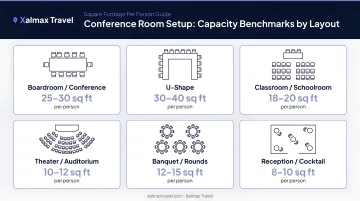
Use these room capacity benchmarks as minimums when assessing space:
| Setup | Sq Ft Per Person |
|---|---|
| Theater (rows) | 9 sq ft |
| Classroom (tables + chairs) | 15 sq ft |
| Banquet (round tables) | 13 sq ft |
| Boardroom/conference | 40–50 sq ft |
Location and Accessibility
Proximity to airports, ground transportation, and hotel room blocks directly affects how energized attendees arrive on day one. For out-of-town events, prioritize:
- Airport within 30–45 minutes
- Sufficient hotel room inventory nearby or on-site
- ADA-compliant facilities throughout (not just at the entrance)
Logistical friction compounds over multi-day events. An inconvenient location costs you attendee energy before the opening session starts.
Contract Terms That Catch Companies Off Guard
Most organizations sign venue contracts without reviewing the clauses that experienced planners negotiate as a matter of course. Specifically:
- Attrition clauses — negotiate a 20% cushion below your contracted room block as a standard allowance
- Cancellation and termination fees — fees scale based on how close to the event date you cancel; understand the schedule before signing
- Exclusive vendor requirements — some venues mandate in-house AV or catering; request the right to bring in outside vendors or negotiate rate caps
- Service charge distribution — confirm whether the 22–25% service charge is distributed to staff or retained by the venue as revenue
Per Skift Meetings, experienced planners also request clauses that lock in quoted rates and cap charges that could escalate if event parameters shift.
How Xalmax Travel Simplifies Venue Selection
All of the above — capacity benchmarks, contract negotiations, vendor rights — takes time and vendor relationships most sales managers and administrative assistants don't have on hand. Xalmax Travel's free venue sourcing service covers it all.
Submit your budget, attendee count, preferred city, and requirements. Xalmax's team draws on a global network of premium hotels and venues to deliver a tailored shortlist with detailed proposals, competitive rates, and confirmed availability. From there, they handle all negotiations, contracts, and logistics — including the contract clauses most companies miss.
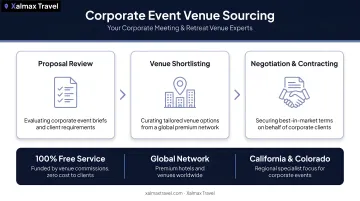
The service costs nothing to clients. Hotels and venues pay the commission, so the expertise and network access come at zero expense to your organization.
For companies running multiple events annually, the Xalmax Rewards program earns points on every booking, redeemable for gift cards and travel perks.
Frequently Asked Questions
How far in advance should you start planning a corporate conference?
Start 6 months out for events under 250 attendees and 9–12 months out for larger or multi-day programs. Earlier planning protects your negotiating position and ensures the most capable venues haven't already committed those dates to other groups.
How much does a corporate event planner cost?
Pricing varies by model: planners typically charge 10–20% of total event expenses, $25–$250 per hour depending on experience and scope, or a flat project fee for well-defined events. Geography, hybrid production requirements, and speaker procurement can all push costs higher.
What are the different types of meeting planners?
The main categories are: in-house corporate planners (employees dedicated to event management), independent freelance planners, full-service event management agencies, and specialized venue sourcing services like Xalmax Travel. The right fit depends on event complexity and how much internal capacity your team has.
What are the 5 C's of event management?
The 5 C's are Concept, Coordination, Control, Culmination, and Closeout. The framework walks planning teams through every phase — from initial goal-setting to post-event review — giving each stage a clear owner and outcome.
What are the 5 P's of event management?
The most widely used formulation is Person, Place, Product, Price, and Promotion — covering team assembly, venue selection, content, budget, and marketing. Each element maps to a core decision area in conference planning, making it a useful checklist for early-stage planning.