According to Harvard Business Review, somewhere between 60–90% of strategic plans never fully launch. That's not a strategy problem — it's a design and execution problem. Most retreats fail because they're structured around presenting plans rather than making choices, and because accountability structures collapse the moment participants return to daily operations.
This guide covers the full arc: how to prepare, how to run two focused days, and how to follow through in a way that actually sticks.
Key Takeaways
- Define the exact deliverables before designing the agenda — 3–5 strategic priorities, not a broad list
- Pre-work (surveys, SWOT, research packets) determines the quality of retreat conversations
- Day 1 builds shared context; Day 2 makes decisions and assigns ownership
- 67% of well-formulated strategies fail due to poor execution, not poor planning — post-retreat accountability is non-negotiable
- Choosing the right off-site venue matters more than most teams assume
How to Run a Strategic Planning Retreat: Step-by-Step
A successful retreat is built in four phases: before, Day 1, Day 2, and after. The work done before the retreat determines the quality of every conversation during it.
Step 1: Define the Outcome Before Anything Else
Before building an agenda, leadership must define the exact deliverables expected from the retreat. Common examples:
- 3–5 strategic priorities for the next 12–36 months
- A refreshed or reaffirmed mission and vision
- A 12-month execution roadmap with named owners
This matters more than it sounds. There's a critical distinction between a strategic planning retreat (where participants co-create strategy) and a planning retreat (where they implement a strategy already decided). Confusing the two reliably generates disengagement and erodes trust in the process.
If the outcome is predetermined, participants will sense it, and the retreat will feel performative.
Start with the deliverables. Then build the agenda backward from there.
Step 2: Do the Pre-Retreat Preparation Work
Without pre-work, the retreat becomes an information-delivery session. The time should be reserved for analysis and decision-making, not catching people up on data they should have reviewed in advance.
Pre-work should include:
- Team effectiveness survey : a brief, confidential assessment of trust and psychological safety levels, sent before participants arrive
- Mission/vision review : distribute the current statement and ask participants to reflect on whether it still holds
- Individual SWOT homework : each participant completes their own SWOT analysis independently before the retreat
All participants should also receive a pre-work packet at least one week in advance containing three research inputs:
- Organizational assessment : current performance data, financials, progress on past priorities
- Competitive/ecosystem scan : market trends, peer benchmarks, external pressures
- Stakeholder input summary : findings from interviews, surveys, or focus groups with key constituents
This pre-work eliminates the need to spend retreat time on information delivery, freeing the entire session for strategic debate.
Step 3: Run the Retreat Across Two Days
Day 1: Build shared context
The first day is not for goal-setting. It's for grounding. The agenda should focus on:
- Walking through the research inputs as a group and surfacing key insights
- Reaffirming or revising the mission and vision based on discussion
- Establishing a shared picture of where the organization actually stands (including uncomfortable truths)
Jumping straight to priorities on Day 1 is one of the most common structural mistakes. Teams that skip context-building spend the rest of the retreat arguing from different starting assumptions.
Day 2: Make decisions
Day 2 is where the real work happens. The structure that works:
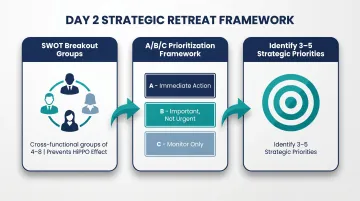
- SWOT analysis in cross-functional breakout groups (4–8 people) : groups work independently to prevent groupthink and the HiPPO effect, where the senior person's view dominates
- Prioritization using an A/B/C framework:
- A = Immediate action required
- B = Important but not urgent
- C = Must monitor, but can't currently control
- Identifying 3–5 strategic priorities from the pattern of A and B factors across all groups
When independent breakout groups reach 80%+ similar conclusions, that's genuine strategic consensus. Wildly divergent conclusions signal an alignment problem the facilitator must address before the group moves forward.
Close with a commitment exercise. Before leaving, every participant either explicitly commits to the plan or surfaces unresolved objections. Leaving with unspoken disagreement is how retreats unravel in the weeks that follow.
Step 4: Execute the Post-Retreat Follow-Through
The strategic plan isn't finished when the retreat ends. It's finished when a Strategic Execution Plan is developed : tactical implementation assigned to the people who own each area, not the same leadership team that designed the strategy.
Two follow-up actions keep momentum from stalling:
- Within 48 hours: send a full recap of decisions made, priorities identified, and owners assigned
- Within 3–6 weeks: schedule a follow-up session to review draft execution plans and surface obstacles
Without this checkpoint, momentum stalls the moment participants return to day-to-day operations.
The numbers here are stark. The Balanced Scorecard Institute reports that 92% of organizations fail to track the KPIs tied to their strategic plans. Build the measurement system into the retreat deliverables, not as an afterthought.
What You Need Before Your Strategic Planning Retreat
Preparation quality directly determines retreat quality. A well-prepared group can accomplish in two days what an unprepared group cannot accomplish in a week.
Team Readiness
Effective strategic planning requires participants to have honest, sometimes uncomfortable conversations — about what's broken, what's been avoided, what the real threats are. That only happens when there's sufficient psychological safety in the room.
Google's Project Aristotle, which studied 180 teams, identified psychological safety as the single most important factor in team effectiveness. Without it, participants default to politically safe input rather than honest assessments.
Send a brief confidential survey before the retreat to assess trust and openness levels. If scores are low, adjust the agenda — prioritize relationship-building activities on Day 1 and use structured anonymous input methods throughout.
Facilitator Decision
Two specific situations make an external facilitator necessary rather than optional:
- The person who would facilitate also needs to contribute to the strategy (you can't do both)
- The team includes dominant personalities or political dynamics that internal leaders are too close to manage
External facilitators bring a proven process and the neutrality to push back on the senior person in the room. They're recommended for any group larger than 10–15 participants or any session involving high-stakes decisions.

Venue and Logistics
Once you've sorted personnel, logistics become the next major variable — and venue selection is where planning most often stalls.
Off-site venues aren't a luxury — they're structural. On-site retreats get interrupted by operational demands, and the physical setting signals to participants whether this time is protected or expendable.
Finding the right venue — one that fits the group size, budget, and the focused atmosphere a strategic retreat requires — is often the most time-consuming part of the planning process. Xalmax Travel offers a free corporate retreat venue sourcing service for exactly this reason. You submit your requirements (meeting city, attendee count, budget, and any special needs), and their team handles the research, proposals, and contract negotiations. Hotels pay the commission, so there's no cost to you.
When Should You Run a Strategic Planning Retreat?
Not every organization needs a full-scale annual retreat. Running one "because it's tradition" without clear purpose wastes resources and erodes team trust in the process.
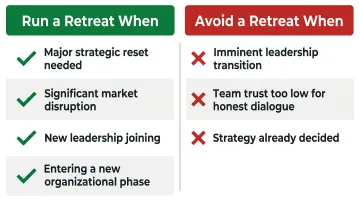
Run a retreat when:
- A major strategic reset is needed — new direction, new market, post-merger integration
- Significant market disruption has changed the competitive landscape
- New leadership has joined and alignment around direction is critical
- The organization is entering a new phase (new product line, geographic expansion, leadership succession)
Avoid running a retreat when:
- A leadership or ownership transition is happening imminently — the strategy will need to be revisited anyway
- Team trust is too low for honest dialogue — the retreat will reinforce existing dynamics rather than break them
- The "strategy" has already been decided and the session would be performative rather than participatory
That last point is the most avoidable mistake. When participants sense the outcome was decided before they walked in the room, the session produces cynicism rather than commitment.
Common Mistakes That Derail Strategic Planning Retreats
Most retreats don't fail because of bad strategy — they fail because of avoidable process errors. Here are the four that come up most often.
Activity disguised as strategy. The most common pattern: teams spend retreat time presenting last year's plan with slightly higher targets. This happens when the agenda is designed around information-sharing rather than decision-making. If no real tradeoffs are being made, it's not a strategy session.
No preparation before arrival. Without SWOT pre-work, stakeholder data, and a baseline team assessment, the group spends the first half of the retreat on information gathering. The research-to-discussion ratio gets inverted, and the actual strategic work gets compressed into whatever time remains.
One voice drowning out the room. This produces strategic plans that reflect the loudest opinion rather than collective intelligence. Structured breakout groups and anonymous input methods exist to prevent this. So does an experienced external facilitator.
Leaving without a commitment structure. The "Monday Gap" — where retreat insights evaporate under the weight of daily operations — is predictable and preventable. It happens when teams leave with rough alignment but no explicit ownership and no follow-up date on the calendar. Close every retreat with names next to actions and dates next to milestones.
Frequently Asked Questions
What is the main purpose of a strategic planning retreat?
A strategic planning retreat brings leadership together in a dedicated, distraction-free setting to assess where the organization stands, define where it's going, and agree on 3–5 priorities that will guide decisions and resource allocation over the next 1–3 years. The goal is alignment on direction — not just agreement on tactics.
What are the key stages of strategic planning?
Three core stages: assessing current state (Where are we now?), defining future direction (Where are we going?), and building the execution roadmap (How will we get there?). A well-run retreat compresses all three into two focused days.
What frameworks are commonly used in strategic planning retreats?
The most widely used are SWOT analysis, PESTLE for external factor analysis, and the Playing to Win framework (defining where to compete and how to win). The right choice depends on the organization's size, maturity, and the specific strategic question being addressed.
How long should a strategic planning retreat last?
Most effective retreats run 1.5 to 2 full days — Day 1 for current state and context-setting, Day 2 for priorities and execution planning. Very large or complex organizations may add a third day, but cognitive fatigue diminishes returns beyond that.
Should you hire an outside facilitator?
An outside facilitator is strongly recommended in three situations:
- The person who would facilitate also needs to contribute to the strategy
- Team dynamics include strong personalities that need managing
- The organization lacks internal expertise in structured strategic processes
What's the difference between a strategic planning retreat and a regular planning meeting?
A planning meeting reviews progress, assigns tasks, or updates an existing plan. A strategic planning retreat is a dedicated, multi-day process for stepping back from operations entirely — examining direction, making tradeoffs, and resetting or reaffirming priorities.