Introduction
Corporate retreats represent a real investment — venue costs, travel, accommodation, and two or three days of leadership attention pulled away from daily operations. Yet a significant number of those retreats produce little beyond a slide deck that no one opens six weeks later.
The problem is rarely intent. Most organizations understand why an offsite matters. What derails them is process — specifically, what happens (or doesn't happen) when there's no skilled facilitator in the room.
Research from McKinsey found that only 45% of executives are satisfied with their strategic planning process, and just 23% said major strategic decisions were actually made within that process. A retreat without effective facilitation rarely closes that gap.
This article outlines 11 concrete benefits of working with a skilled retreat facilitator — grounded in what changes when the right person is running the room.
Key Takeaways
- A skilled facilitator brings structure, neutrality, and process expertise that no internal leader can provide while also participating in discussions
- Facilitators prevent the most common retreat failures: dominant voices, circular conversations, vague commitments, and zero follow-through
- The 11 benefits fall into three areas: process and structure, people and group dynamics, and outcomes and accountability
- The facilitator's value extends well beyond the session itself — pre-retreat prep and post-retreat follow-up are just as critical
What Is a Retreat Facilitator?
A retreat facilitator is a trained, neutral professional who designs and guides the process of a retreat so participants can focus entirely on the content.
A consultant tells your team what to do. A facilitator creates the conditions for your team to figure it out together, which produces stronger buy-in and better follow-through. No one pushes back on a plan they helped build.
The International Association of Facilitators describes facilitation as "the art of helping a group think together, explore options, and make decisions." In a retreat context, that translates to a structured day (or days) where every conversation has a purpose, every voice gets space, and the session closes with decisions — not just themes.
A skilled facilitator shapes whether the retreat ends with real decisions and clear next steps — or just a long list of conversation topics no one acts on.
11 Benefits of an Effective Retreat Facilitator
These benefits are organized into three categories because that's how they show up in real retreats: how the session is structured, how people interact within it, and what the organization walks away with.
Process and Structure Benefits
Benefit 1: A custom agenda built around your actual goals
Generic retreat agendas are everywhere. Effective facilitators don't use them.
Before the session, a skilled facilitator conducts stakeholder interviews, reviews existing plans and performance data, and works with leadership to define what a successful retreat looks like. That preparation translates into an agenda where every time block has a specific purpose tied to a specific outcome.
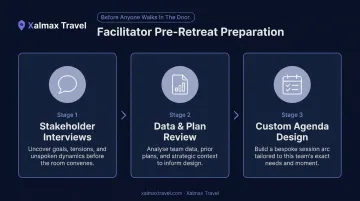
McKinsey's research on strategy offsites recommends keeping pre-reading to around 10 pages — no more than 25 — because engagement drops sharply when participants arrive overloaded. A facilitator manages that calibration before anyone walks in the door.
Benefit 2: Discussions stay on track, time doesn't disappear
Every retreat has at least one conversation that could consume the entire day. A trained facilitator knows the difference between a productive tangent worth pursuing and a distraction worth redirecting — and they can make that call without shutting people down or creating friction.
HBR's research on meetings found that 71% of senior managers describe meetings as unproductive and inefficient. Part of that is structure, part of it is time management. A facilitator addresses both simultaneously.
Benefit 3: Leaders can actually participate
An internal leader who tries to facilitate their own team's retreat always compromises one role. They're either managing the process (and missing the discussion) or contributing to the discussion (and losing control of the process).
An outside facilitator resolves this completely. Your CEO, board chair, or team lead can offer their perspective, push back on assumptions, and engage in real dialogue, without splitting their attention between the conversation and the clock. The quality of their contribution goes up noticeably.
People and Group Dynamics Benefits
Benefit 4: Objective neutrality changes the quality of conversation
An internal facilitator brings relationships, history, and hierarchy into the room whether they intend to or not. An external facilitator brings none of that.
Research published in Design Science found that high facilitator impartiality had a statistically significant positive impact on team trust (p < 0.05). When participants trust that the process is fair, they engage more honestly — including on topics that internal leaders might unconsciously steer around.
Benefit 5: Conflict becomes productive rather than derailing
Retreats surface tension. That's partly the point — bringing people together to work through hard questions creates the conditions for disagreement. The question is whether that disagreement becomes productive or destructive.
A trained facilitator knows how to de-escalate without suppressing. They can hold space for a genuine dispute, ensure both positions are heard clearly, and redirect toward resolution without making anyone feel dismissed. Left unmanaged, one contentious exchange can consume an afternoon.
Benefit 6: Quieter voices get heard — and they often have the best input
In unstructured group discussions, the loudest voices set the direction. HBR describes this as the HiPPO effect — decisions driven by the highest-paid person's opinion rather than the best available thinking.
Skilled facilitators use structured techniques to counteract this:
- Anonymous input methods — digital or written submissions before open discussion
- Small group breakouts — where quieter participants engage more freely
- Structured rounds — where every person speaks before open debate begins
- Nominal Group Technique — silent idea generation followed by organized sharing and voting
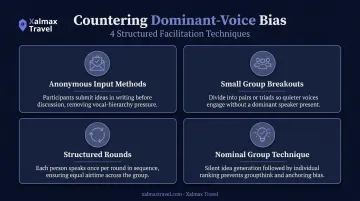
These aren't process tricks. They consistently produce a wider range of ideas and stronger collective ownership of outcomes.
Benefit 7: Cross-organizational context reduces anxiety and speeds decisions
An experienced facilitator has sat in dozens, sometimes hundreds, of rooms like yours. They've seen similar organizations wrestle with similar questions and reach similar crossroads. That pattern recognition is genuinely useful.
When a team gets stuck in a loop, a facilitator can say with credibility that the challenge is common, that other organizations have navigated it, and that proven frameworks exist for moving through it. That context reduces the anxiety that can paralyze a group and shortens the time it takes to reach a decision.
Outcome and Accountability Benefits
Benefit 8: Proven frameworks keep decisions from spinning
Open-ended strategic conversation without structure tends to produce the same discussion on repeat. A facilitator brings methodologies — SWOT analysis, prioritization matrices, strategy development frameworks — that move a group from exploration to decision.
These aren't rigid scripts. A good facilitator adapts the tool to the conversation. But having a framework means the group doesn't have to invent a process mid-session, and it ensures the output is structured enough to act on.
Benefit 9: The retreat ends with real action items, not good intentions
The most common failure mode of a self-facilitated retreat: the session closes with a list of "things to think about" and no one assigned to think about any of them.
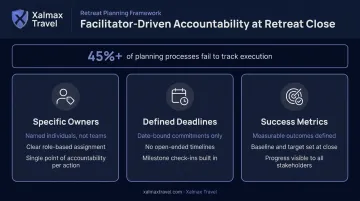
McKinsey found that more than 45% of planning processes fail to track the execution of strategic initiatives. An effective facilitator builds accountability into the closing phase — specific owners, defined deadlines, and success metrics that make the next step obvious. The difference between a retreat that produces momentum and one that produces a document is whether someone leaves with their name next to a commitment.
Benefit 10: Energy and engagement hold through the full day
A poorly paced retreat runs out of gas by 2 p.m. Participants are still present, but the quality of thinking has dropped noticeably.
Facilitators design against this deliberately. They alternate between high-intensity discussions and lower-stakes activities, build in structured breaks, and vary the format (individual reflection, small groups, plenary) to maintain cognitive engagement across a long day. A systematic review published in PMC confirmed that micro-breaks help maintain vigor and reduce fatigue — a finding skilled facilitators apply instinctively through pacing.
Benefit 11: Post-retreat follow-through is part of the job
The retreat ends. Participants go home. Three weeks later, the energy has dissipated and the action items are buried under email.
Effective facilitators prevent this with structured post-session support, typically including:
- A written summary capturing decisions made, owners assigned, and next steps due
- Follow-up check-ins at 30 or 60 days to hold accountability and surface early blockers
This is exactly where self-facilitated retreats fall apart. No one has the bandwidth to synthesize output, chase commitments, and keep their regular job moving. The facilitator's role doesn't end when the room clears.
What Happens When Retreat Facilitation Falls Short
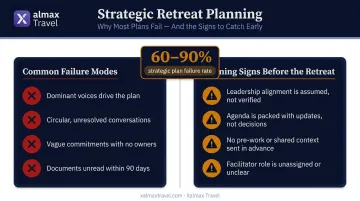
The failure modes of a poorly facilitated retreat are predictable:
- The most senior or most vocal person drives the plan
- Conversations repeat themselves without resolution
- The session closes with vague commitments and no clear owners
- The resulting document sits unread within 60–90 days
Kaplan and Norton's research on strategy execution reports failure rates of 60–90% for strategic plans — and one consistent driver is the absence of a follow-up mechanism after planning sessions. A retreat without a facilitator rarely produces that follow-up mechanism.
The cost compounds quickly. Beyond the direct spend — venue, travel, accommodation, catering — there's the opportunity cost of your leadership team's full attention for two to three days. When that investment produces nothing actionable, you don't just lose money — you lose organizational momentum and leadership alignment that can take months to rebuild.
Warning signs your retreat is at risk:
- An internal leader is expected to both facilitate and participate
- No stakeholder interviews or pre-work before the session
- No documented action plan at the close of the last day
- No follow-up mechanism scheduled after the event
How to Get the Most Value from Your Retreat Facilitator
A facilitator is only as effective as the access and context you give them. The preparation phase — before anyone arrives at the venue — is where much of the value is built.
Before the retreat:
- Share your goals clearly and early — what does a successful outcome look like?
- Arrange stakeholder interviews so the facilitator understands the political landscape, not just the stated agenda
- Provide existing plans, prior retreat outputs, and any relevant performance data
- Brief participants on what the facilitator's role is and what equal participation means
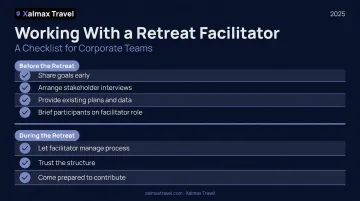
During the retreat:
- Let the facilitator manage process — resist the urge to redirect from the room
- Trust the structure, especially when conversations feel uncomfortable
- Come prepared with the context needed to contribute, not just to listen
On venue selection:
The environment matters more than most organizations admit. A distracting or poorly chosen venue forces the facilitator to work against the space rather than with it. The right location — genuinely away from day-to-day operations, with appropriate room setup, natural light, and minimal interruptions — directly supports the facilitator's ability to keep the group engaged and focused.
For corporate groups navigating that decision, Xalmax Travel's free venue sourcing service matches your group's size, goals, and budget to the right setting. Share the basics, and Xalmax handles the rest:
- Curated venue options across top destinations — Napa wine country, Vail mountain lodges, Santa Barbara resorts, and more
- Detailed proposals with negotiated rates tailored to your budget
- Full contract and logistics management at no cost to you
You provide city preference, attendee count, and budget. Xalmax delivers the shortlist.
Conclusion
The 11 benefits of an effective retreat facilitator — from agenda design and time management to conflict resolution and post-retreat accountability — all point toward the same outcome: a retreat that produces decisions your team will actually implement.
None of these benefits appear automatically. They compound when the facilitator relationship is treated as a genuine partnership: the more context, access, and preparation you invest before the session, the more value the facilitator can generate during and after it.
For organizations that use retreats to set direction, build alignment, or navigate meaningful change, a skilled facilitator isn't optional. Neither is getting the environment right — the venue shapes the tone, energy, and focus that a facilitator needs to do their best work. If you're planning an executive or team-building retreat and need a venue that matches your goals and budget, Xalmax Travel sources options at no cost to you.
Frequently Asked Questions
Frequently Asked Questions
What is strategic planning?
Strategic planning is the process by which an organization defines its direction, sets priorities, and allocates resources to achieve long-term goals. A retreat facilitator makes this process structured and concrete, guiding the group from open-ended discussion to documented decisions with clear owners and timelines.
What are the key steps or elements of strategic planning?
The core elements are: assessing current state (typically through SWOT analysis), defining vision and strategic priorities, setting goals with clear owners and timelines, and building a follow-up mechanism to track execution. A retreat facilitator moves the group through each stage in sequence, preventing the common pitfall of cycling back without resolution.
What are the 5 C's of strategic planning?
The 5 C's — Company, Customers, Competitors, Collaborators, and Context — are a framework for analyzing an organization's operating environment. A retreat facilitator structures exercises around each dimension so leadership teams work through them methodically, rather than debating them without structure.
What is the difference between a retreat facilitator and a consultant?
A consultant diagnoses your situation and prescribes a solution. A facilitator creates the conditions for your team to develop direction together. The distinction matters practically: plans your team builds themselves carry stronger ownership and are significantly more likely to be implemented.
How much does a retreat facilitator typically cost?
Day rates vary widely based on experience, scope, and pre/post-retreat deliverables, with professional facilitators commonly charging anywhere from a few thousand dollars to $10,000+ per day. Factor in what a poorly executed retreat costs — venue, travel, lost productivity, and a plan that never gets implemented — when weighing that investment.
Can an internal leader facilitate their own team's retreat?
Technically yes, but practically, almost never well. You cannot simultaneously manage group dynamics and contribute meaningfully to the discussion. Internal leaders also carry existing relationships, authority, and organizational biases that shape what people say (and don't say) in the room.