Introduction
Senior executives are the most time-constrained people in any organization, and yet the decisions they make together — or consistently fail to make — determine everything downstream. Product strategy, talent priorities, cultural direction, capital allocation: all of it flows from how well the leadership team thinks as a unit.
The problem? Most C-suite teams get very little genuine, uninterrupted time together. Quarterly reviews run on crisis energy. Board meetings focus on reporting. One-on-ones stay in their lanes.
The result is a leadership team that's technically aligned on paper but privately fragmented. The organization always feels it.
McKinsey's 2025 research found that aligned executive teams are 1.9 times more likely to achieve above-median financial performance, yet the average top team scores only 44 out of 100 on effectiveness. That gap is where a well-designed leadership retreat does its real work.
This guide covers what makes an executive retreat high-impact, the strategic goals it should serve, how to build an agenda that delivers, and how to measure ROI after the fact.
Key Takeaways
- Aligned leadership teams outperform financially by nearly 2x; retreats are the primary tool for building that alignment
- High-impact retreats balance strategic sessions, genuine relationship-building, and leadership renewal (not just strategy decks)
- Every planning decision — agenda, venue, facilitation — should flow from outcomes defined before venue or agenda planning begins
- ROI is measurable: track decision speed, initiative execution rates, and alignment scores before and after the retreat
What Separates a High-Impact Executive Retreat from a Standard Offsite
Moving a quarterly meeting to a hotel conference room doesn't make it a retreat. An executive retreat becomes high-impact through deliberate design: defined outcomes, professional facilitation, a venue that removes leaders from operational noise, and a structured balance between strategy, connection, and renewal.
The distinction isn't just semantic. A high-impact retreat changes how the leadership team thinks and operates together — an offsite meeting changes only the zip code.
The Science Behind Location
There's a neurological reason venue selection matters beyond aesthetics. A 2023 scoping review of 33 empirical studies found that visual stimulation and spatial variety are among the most significant physical factors influencing creative output in professional settings. High-ceilinged rooms with natural light and varied spatial design measurably increase divergent thinking — the kind of thinking that produces strategic breakthroughs rather than incremental adjustments.
A separate 2024 randomized controlled trial found that even a 40-minute nature walk enhanced executive control at a neural level, with an effect size of Cohen's d = 0.41. That's a meaningful effect from a single walk. Environment shapes cognition — which means venue selection is a design decision with measurable consequences, not just a preference.
Why Senior Executive Retreats Require Different Design
These environmental factors carry even more weight at the executive level. Manager and team retreats have different stakes, different time constraints, and different group dynamics — and executive retreats demand design that accounts for all three.
- Deliver content that respects seniority and strategic depth — senior leaders disengage quickly from generic material
- Execute logistics flawlessly — friction a team-level group tolerates becomes a credibility problem at the C-suite level
- Use skilled facilitation that can professionally manage high-status, competitive group dynamics
- Build in genuine white space — overscheduling signals poor planning and eliminates the reflection time that makes retreats transformative
Signs a Leadership Retreat Is Overdue
Watch for these indicators that your executive team needs structured time together:
- Leaders agree in meetings but contradict each other in execution
- Strategic decisions keep getting relitigated rather than acted on
- High performers are quietly disengaging or signaling frustration
- Cross-departmental communication has broken down or become territorial
Strategic Goals Every Senior Leadership Retreat Should Achieve
A well-designed retreat doesn't try to accomplish everything — it accomplishes the right things. These five goals give event planners and leadership teams a clear framework for building an agenda that actually moves the needle.
Goal 1: Strategic Alignment
Most executive teams only meet formally under the pressure of quarterly reviews or crises — environments that compress thinking rather than expand it. A retreat is the one context where leaders can step back from short-term agendas and genuinely align on long-term vision, shared priorities, and strategic ownership.
The data on why this matters: McKinsey found that 43% of CEOs say they spend too little time developing long-term strategy, and 16% report spending too much time just trying to get their own executive team aligned. A retreat addresses both problems simultaneously.
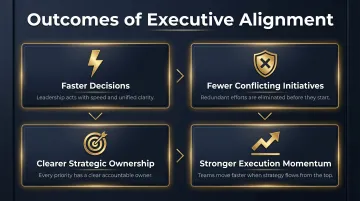
The downstream effects of that alignment are measurable:
- Faster decisions with less back-and-forth between departments
- Fewer conflicting initiatives competing for the same resources
- Clearer ownership of strategic priorities across the leadership team
- Stronger execution momentum at every level of the organization
Goal 2: Trust and Relationship Depth
Trust between senior leaders is the currency that difficult decisions, honest conversations, and calculated risks run on. Without it, leaders default to protecting their own domain rather than optimizing for the whole.
Retreats create conditions for executives to see each other as people rather than titles. That relational depth — built through shared experiences, informal meals, and candid one-on-ones — pays dividends in execution speed long after the retreat ends.
Goal 3: Innovation and Fresh Thinking
The daily operational grind suppresses strategic ideas. There's simply no bandwidth for cross-functional exploration when everyone is managing their own function's fires.
Retreats break organizational silos by putting leaders in a low-pressure, collaborative environment. When cognitive openness — driven by a change of setting — meets cross-functional proximity, strategic ideas that would never surface in a weekly standup start to emerge. New product directions, smarter processes, and long-overdue pivots all become fair game.
Goal 4: Leadership Renewal and Resilience
Executive burnout is not a personal problem — it's an organizational risk. Deloitte's 2023 Well-being at Work Survey found that 75% of the C-suite say they are seriously considering quitting for a role that better supports their well-being. DDI's 2025 Global Leadership Forecast adds that 40% of stressed leaders have considered leaving leadership roles entirely.
Fatigued leaders make fatigued decisions. Wellness and recovery programming in a retreat isn't an indulgence — it's preventative maintenance for the organization's most critical asset.
Goal 5: Culture Reinforcement and Values Alignment
Company values drift when they aren't actively practiced at the top. Retreats provide structured time to reconnect the leadership team to organizational purpose, assess where culture actually is versus where it should be, and model the behaviors that cascade through every layer of the company.
What to Include in Your Executive Retreat Agenda
Strategic Planning and Goal-Setting Workshops
These sessions are the foundation. Facilitated workshops where leaders define or revisit key priorities, map scenarios, and assign ownership to strategic outcomes work best when led by an objective external facilitator who can manage group dynamics and prevent dominant personalities from narrowing the conversation.
The facilitator's role is to keep discussion productive without letting it collapse into consensus-by-exhaustion.
Leadership Development and Skill-Building
Day-to-day operations leave almost no time for senior leaders to develop as leaders. Retreats flip that dynamic. Effective skill-building sessions for executive audiences cover:
- Decision-making under pressure and ambiguity
- Conflict resolution between peers (not subordinates)
- Communication clarity and executive presence
- Emotional intelligence and self-regulation
Incorporating 360-degree feedback exercises or leadership style assessments adds another layer. Done well, these create self-awareness that performance reviews rarely achieve — because the feedback comes from peers, not just direct reports or managers.
Team-Building Experiences That Create Real Connection
The most effective options for senior executives feel adult and natural, not engineered. Consider:
- Shared adventure activities (hiking, kayaking, culinary workshops)
- Storytelling circles where leaders share defining professional moments
- Role-swap simulations that build cross-functional empathy
One underrated element: the informal time between sessions. Meals, evening conversations, and unstructured downtime are where much of the real trust-building happens. Don't over-program it out of existence.
Structured Reflection and Feedback Time
Retreats deliver lasting value when they include time for executives to process individually and collectively. Guided reflection, journaling prompts, or small-group discussion sessions allow leaders to internalize insights and plan practical application.
Structured peer feedback rounds — framed as developmental dialogues, not performance evaluations — surface blind spots that one-on-one reviews rarely reach. When a skilled facilitator sets clear norms upfront and keeps the group focused on growth rather than judgment, these sessions are consistently cited as the most impactful part of the entire retreat.
Wellness and Recovery Programming
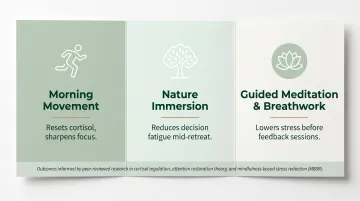
A 2023 meta-analysis of 111 randomized controlled trials found that mindfulness-based interventions produce measurable improvements in executive functioning, attention, and memory — with breathwork showing comparable results for acute stress reduction. Morning movement, nature immersion, and guided meditation directly improve the quality of strategic thinking in the sessions that follow:
- Morning movement resets cortisol levels and sharpens focus before high-stakes discussions
- Nature immersion reduces decision fatigue, particularly useful mid-retreat
- Guided meditation or breathwork lowers baseline stress before feedback-heavy sessions
How to Plan a Senior Leadership Retreat: A Step-by-Step Guide
Step 1: Define Outcomes Before Anything Else
Every subsequent decision flows from this step. Before contacting a venue or drafting an agenda, document the specific results the retreat must produce. Examples:
- Align on a 3-year growth strategy with clear ownership
- Rebuild trust and communication between two divisions
- Define succession plans for two key leadership roles
Vague objectives produce vague retreats. If you can't write down what success looks like, you're not ready to start planning.
Step 2: Build the Agenda Around Outcomes, Not Preferences
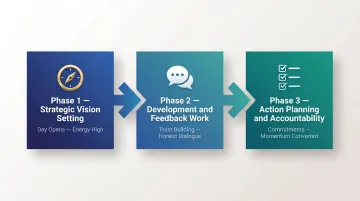
Sequence matters. A purposeful executive retreat agenda typically moves through three phases:
- Open with strategic or vision-setting work — energy is high, the group is fresh, and this framing sets the tone for everything that follows
- Move into development and feedback work mid-retreat — trust is building, the group is more comfortable with honesty
- Close with action planning and accountability assignments — momentum from the retreat gets converted into specific commitments
The most common planning mistake is overscheduling. A balanced day includes two to three focused sessions with meaningful downtime between them. Senior executives need breathing room to process — that white space is where insights crystallize.
Step 3: Choose a Venue That Serves the Retreat's Goals
Venue selection should be driven by the retreat's tone and objectives:
- Mountain or nature settings — encourage reflection, strategic thinking, and cognitive reset
- Coastal or resort properties — promote creative energy and relaxed relationship-building
- Urban conference facilities — maximize accessibility for executives with tight schedules
The right venue removes operational distractions, supports the collaboration format you've designed, and handles accommodation, AV, and catering logistics seamlessly. Logistics friction at this level of retreat damages the experience and the planner's credibility.
Venue sourcing is also one of the most time-consuming parts of the planning process — researching properties, comparing rates, coordinating outreach, and negotiating contracts all before a single agenda item gets scheduled. Xalmax Travel offers a free venue sourcing service for corporate retreats: submit your requirements (city, budget, attendee count, any special needs), and their team returns detailed proposals with negotiated rates drawn from a wide network of corporate-grade hotels and venues.
They handle the full process — outreach, contract review, and logistics coordination — through to final confirmation. There's no cost to you; venues pay the commission directly.
How to Measure the ROI of Your Leadership Retreat
ROI starts before the retreat begins. Establish baseline metrics in advance so you can measure what actually changed.
Pre-retreat baselines to capture:
- Strategic alignment confidence (survey the leadership team)
- Cross-team trust scores
- Leadership engagement levels
- Time spent relitigating decisions vs. executing them
Post-retreat metrics to track:
- Decision speed and initiative completion rates at 30 and 90 days
- Cross-functional collaboration frequency
- Follow-through on strategic commitments made during the retreat
The financial case is straightforward once you have numbers. SHRM reports that replacing an executive-level employee costs 50% to 200% of their annual salary. A retreat that meaningfully reduces turnover risk among even one C-suite member covers its own cost many times over.
Factor in faster strategic decisions, reduced initiative duplication, and improved execution rates, and the total value case is hard to ignore.
Turning Retreat Outcomes Into Results
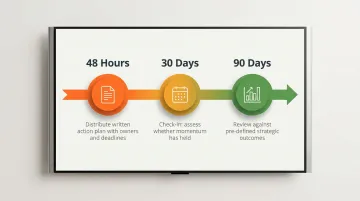
ROI is realized through what happens after the retreat, not during it. Three steps drive follow-through:
- Distribute a written action plan with owners and deadlines within 48 hours of closing
- Run a 30-day check-in to assess whether momentum has held
- Conduct a 90-day review against the strategic outcomes you defined before the retreat started
Frequently Asked Questions
Are corporate retreats worth the investment?
Yes. Aligned executive teams are 1.9x more likely to achieve above-median financial performance, and organizations that invest in leadership development are 1.5x more likely to rank among top financial performers. ROI compounds when retreats are well-designed and paired with post-retreat accountability.
How much does a corporate retreat cost?
Costs vary widely based on group size, duration, location, and activities. Working with a free venue sourcing service like Xalmax Travel cuts out hours of research and vendor outreach without affecting venue quality — venues pay the commission, so the sourcing service costs your organization nothing.
What makes a great executive retreat?
Five elements: clearly defined outcomes, a balanced agenda that respects both strategic and relational needs, the right venue, strong external facilitation, and disciplined post-retreat follow-through. Miss the follow-through and even the best retreat loses its momentum within weeks.
What do you do at a leadership retreat?
The core activity types include strategic planning workshops, leadership development and skill-building sessions, team-building experiences, structured reflection and peer feedback time, and wellness programming. The mix shifts based on whether the retreat is primarily focused on alignment, development, or recovery.
What is a senior executive leadership program?
Senior executive leadership programs combine strategic planning, executive coaching, and peer learning for an organization's most senior leaders. A well-designed leadership retreat is an immersive, concentrated version of this — compressing development and alignment work into a focused offsite format.