Introduction
Recognition isn't a nice-to-have anymore. For HR leaders managing hybrid teams, high turnover, and tighter budgets, structured rewards programs have become one of the most practical tools available.
The data backs this up. According to Gallup's 2024 research, employees who don't feel adequately recognized are 2x as likely to say they'll quit within the next year. Flip that around: Gallup-Workhuman's 2024 findings show well-recognized employees are 45% less likely to have turned over two years later. That's a meaningful retention advantage — one that shows up in headcount and hiring costs.
But not all programs deliver those outcomes. Generic reward structures, one-size-fits-all gift cards, and platforms that nobody actually uses are just as common as the ones that work. This guide helps you tell the difference.
Inside: a comparison of five top employee rewards platforms for 2026, the reward types worth budgeting for, a framework for choosing the right system, and practical advice on avoiding the mistakes that sink most programs.
Key Takeaways
- Employees who feel unrecognized are 2x more likely to leave — structured rewards programs directly address this retention risk
- The best 2026 platforms combine peer-to-peer recognition, real-time automation, and analytics that tie recognition to business outcomes
- Top picks include Awardco, Nectar, Bonusly, WorkTango, and Achievers — each suited to different company sizes and needs
- Key selection factors: catalog flexibility, pricing transparency, HR integrations, and analytics capabilities
- Experiential rewards like incentive trips, offsites, and executive retreats are increasingly used alongside digital platforms to drive deeper engagement
Overview of Employee Rewards Programs
An employee rewards program is a structured system through which companies offer tangible incentives — bonuses, gift cards, experiences, merchandise — to recognize performance, loyalty, and contribution. Rewards (tangible) and recognition (intangible acknowledgment like a public shoutout or thank-you) aren't the same thing. The most effective programs combine both: recognition provides context, rewards reinforce the moment.
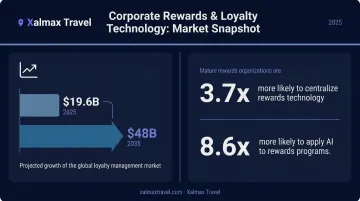
The market for these tools has grown substantially. Future Market Insights projects the employee recognition software market will reach USD $19.6 billion in 2025, rising to USD $48 billion by 2035 — a 9.4% CAGR. With 52% of remote-capable employees now working in hybrid arrangements, companies need digital infrastructure to maintain culture and recognition across distributed teams — and the software market is expanding to meet that demand.
Deloitte's 2025 research adds a competitive angle: mature rewards organizations are 3.7x more likely to centralize rewards technology into a single portal — and 8.6x more likely to apply AI and automation to rewards delivery. For HR teams still managing recognition through spreadsheets and manual workflows, these numbers signal a structural disadvantage — not just an efficiency gap.
The five platforms below were evaluated on catalog depth, pricing transparency, peer-to-peer capabilities, ease of use, HR integrations, and analytics. Each earns its spot for a different reason.
Best Employee Rewards Programs of 2026
Evaluation criteria:
- Reward catalog depth and global reach
- Pricing transparency
- Peer-to-peer capabilities
- Admin and employee usability
- Integration with HR and communication tools
- Built-in analytics
Awardco
Awardco is a full-service recognition and rewards platform built around Amazon Business integration. As the first platform in the employee recognition space to partner with Amazon Business, it gives employees access to one of the broadest product catalogs available on any rewards platform. The service supports 163 countries, over 6 million users, and organizations ranging from fast-growing startups to enterprise-scale businesses.
Key features include Bonus Boxes, digital MemoryBooks, automated milestone reminders for anniversaries and birthdays, and native integrations with Slack and Microsoft Teams. In 2025, Awardco added AI-powered recognition quality scoring — which surfaces recognition themes and measures message quality in the recognition feed, helping organizations ensure recognition consistently reflects company values.
| Category | Details |
|---|---|
| Pricing | Small business packages start at $3,000/year; custom pricing for larger teams |
| Key Features | Amazon Business integration, Bonus Boxes, MemoryBooks, automated milestones, Slack/Teams integration, 163-country support, AI quality scoring |
| Best For | Growing teams and multinational businesses needing full-service, globally accessible rewards |
Nectar
Nectar is a peer-to-peer recognition and rewards platform built primarily for SMBs and remote-first teams. Its reward catalog spans Amazon goods, gift cards from hundreds of brands, company swag, charity donations, and customizable options — with pricing that's transparent relative to many competitors.
A notable differentiator: Nectar has a formal SHRM partnership, with SHRM members receiving 10% off subscriptions. The platform also features a refreshed mobile app, multi-language support, and a Shoutouts Report that helps HR teams track recognition equity across the organization — useful for identifying which departments or demographics are being recognized less frequently.
| Category | Details |
|---|---|
| Pricing | Custom pricing; contact for a quote. SHRM members receive 10% off |
| Key Features | Peer-to-peer recognition, Amazon integration, global gift card catalog, company swag, automated milestone celebrations, AI-powered internal comms tool |
| Best For | Companies of 50–2,000 employees prioritizing flexible rewards and frequent platform updates; SHRM members benefit from discounted pricing |
Bonusly
Over 3,400 organizations — including SurveyMonkey and Headspace — use Bonusly for points-based recognition. Employees can tag colleagues, allocate points, and apply company value hashtags in seconds — and the interface consistently earns high marks for usability.
The reward catalog includes 1,200+ gift cards redeemable in 200+ countries, branded swag through an AXOMO integration, and curated physical gifts. Bonusly integrates with Slack, Teams, Workday, Rippling, and Paylocity. Its 14-day free trial requires no credit card — one of the lowest-friction entry points in the category — and it offers discounted pricing for nonprofits and education organizations.
| Category | Details |
|---|---|
| Pricing | Free plan for up to 8 users; Team plan at $3/seat/month; Organization plan custom-priced |
| Key Features | 1,200+ global gift cards, branded swag via AXOMO, Slack/Teams integrations, automated milestone recognition, peer-to-peer points, 14-day free trial |
| Best For | Companies of 50–5,000 employees focused on peer recognition culture with a globally accessible, easy-to-adopt platform |
WorkTango
WorkTango is an all-in-one employee experience platform covering recognition, rewards, incentives, service awards, and employee surveys. Its rewards marketplace features 10 million+ options — from retail gift cards to charity donations — and it has documented client success with organizations like Rexall.
WorkTango's strongest suit is automation. Timely milestone shoutouts, gamified incentive programs, built-in wishlists, personalized reward suggestions, and group redemption options make it well-suited for teams that need recognition to run consistently without manual admin effort. A real-time reporting dashboard ties recognition activity to program health metrics.
| Category | Details |
|---|---|
| Pricing | Minimum 12-month contract; custom pricing — contact for a quote |
| Key Features | 10M+ reward catalog, automated milestone recognition, gamification, incentive programs, wishlists, real-time analytics dashboard |
| Best For | Mid-market and enterprise organizations that want an automation-first recognition culture, particularly in tech, healthcare, financial services, and business services |
Achievers
Achievers is an enterprise-grade platform serving large global organizations. It operates a localized vendor network in approximately 190 countries and offers a concierge redemption model — employees can request virtually any legal reward, and Achievers will source it through its global network. The platform integrates natively with Workday, Slack, Outlook, and multiple major HRIS systems.
One standout pricing detail: Achievers charges no markup on rewards — a meaningful advantage for enterprises managing large reward budgets where hidden fees compound quickly. Built-in DEI and fairness analytics help organizations track whether recognition is being distributed equitably across teams.
| Category | Details |
|---|---|
| Pricing | Custom pricing; demo required for accurate quote; no markup on rewards |
| Key Features | ~190-country global fulfillment, concierge reward sourcing, cash-like gift cards, swag, travel perks, real-time budget controls, Workday/Slack/Outlook integrations |
| Best For | Large global organizations needing enterprise-grade budget governance, flexible reward fulfillment, and compliance-ready recognition infrastructure |
Types of Employee Rewards to Consider in 2026
Rewards fall into two broad categories, and the research consistently favors using both:
Monetary rewards:
- Performance bonuses and cash awards
- Gift cards (employees prefer these over cash — IRF research found 37% of workers chose gift cards as their top incentive vs. 29% who chose cash)
- Profit-sharing and spot bonuses
Non-monetary rewards:
- Public recognition and peer shoutouts
- Additional paid time off
- Professional development and skill-building opportunities
- Wellness perks and mental health support
- Experiences and events
The Rise of Experiential Rewards
Experience-based rewards are getting serious budget attention in 2026. The IRF 2025 Trends Report reports that 81% of organizations cite retaining talented employees as the top reason for investing in incentive travel. They function as retention tools with measurable impact.
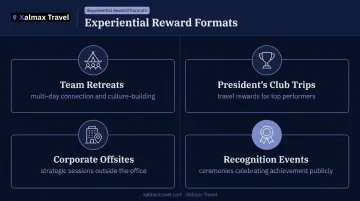
Team retreats, corporate offsites, and President's Club trips create shared memories that a gift card can't replicate. They build culture, reinforce belonging, and signal to top performers that the organization invests in them beyond their paycheck. Common formats include:
- Team retreats — multi-day offsites focused on connection and culture-building
- President's Club trips — travel rewards for top performers, typically tied to annual targets
- Corporate offsites — strategic planning sessions held outside the office environment
- Recognition events — award ceremonies or milestone dinners that celebrate achievement publicly
For companies ready to add retreat or offsite experiences to their rewards strategy, Xalmax Travel offers a free venue sourcing service — sharing your budget, attendee count, and destination preferences is all it takes to get started. Their team handles RFP distribution, venue comparisons, negotiations, and contract review at no cost, since hotels and venues pay their commission.
Matching Rewards to Your Workforce
No single reward type works for everyone. Consider these variables:
- Work arrangement — remote employees may value gift cards and virtual experiences differently than in-office teams who can share physical gatherings
- Workforce demographics — 78% of younger Millennials and Gen Z workers want recognition from their manager at least a few times per month, suggesting frequent, lighter-touch recognition matters as much as big annual awards
- Company values — if sustainability or wellness are organizational priorities, reward options should reflect those values
Survey employees annually. Ask them to rank 3-4 reward types by preference — the answers will tell you more than any benchmark report.
How We Chose the Best Employee Rewards Programs
Evaluation Criteria
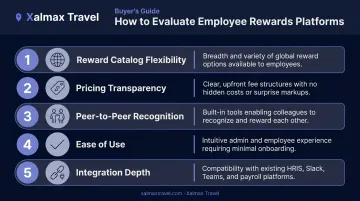
Each platform was assessed across five dimensions:
- Reward catalog flexibility and global reach — works for employees across every location where your company operates, not just headquarters
- Pricing transparency — costs are clear upfront, including setup fees and reward markups that can quietly inflate a "low-cost" platform
- Peer-to-peer recognition — employees can recognize each other, not just receive top-down awards
- Ease of use — adoption is realistic for admins and employees alike, not just during onboarding
- Integration depth — connects with your existing HR systems, payroll tools, and communication platforms without custom development
Understanding what separates good platforms from great ones is only half the equation. Even well-funded programs fail — usually for the same avoidable reasons.
Common Mistakes to Avoid
- Choosing based on brand name without verifying catalog usefulness in your employees' actual locations
- Ignoring total cost — setup fees, admin fees, and markups can inflate a "low-cost" platform by 40-60% once you run the numbers
- Skipping manager buy-in — SHRM reports that 73% of managers receive no formal training on how to recognize employees effectively; a platform won't fix a recognition culture problem if managers aren't involved
- Not tracking participation — redemption rates, recognition frequency, and engagement scores tell you whether a program is fading before it's already dead
- Overlooking personalization — SHRM's 2026 research found only 10% of employees strongly agree their recognition feels personal; catalog breadth matters far less than catalog relevance
Conclusion
The best employee rewards program isn't the most expensive or the most feature-loaded. It's the one employees actually use, that managers consistently support, and that HR can measure against real outcomes like retention, engagement, and productivity.
Start with a pilot before committing to a long-term contract. Gather employee feedback within the first 90 days. Treat it as a living program that evolves with your team, not a system you configure once and forget.
If team retreats or incentive travel are part of your rewards strategy — or you're considering adding them — Xalmax Travel's free venue sourcing service removes the research and logistics work from your team's plate. Whether you're planning a President's Club trip, a team-building offsite, or an executive retreat, Xalmax handles RFPs, venue comparisons, negotiations, and contracts at no cost to your organization.
Reach out at customerservice@xalmax.com or call 347-688-2572 to get started.
Frequently Asked Questions
What is the difference between employee rewards and employee recognition?
Recognition is the intangible acknowledgment of an employee's effort or achievement — a public shoutout, a thank-you note, a manager's verbal appreciation. Rewards are tangible incentives: gift cards, bonuses, experiences. The most effective programs use both together, with recognition providing context and rewards reinforcing the moment.
How much should companies budget for an employee rewards program?
WorldatWork's recognition research found that 51% of companies spend between 0.1% and 0.3% of payroll on recognition programs. Smaller companies can start lean — Bonusly is free for up to 8 users, and the Team plan runs $3/seat/month. Reduced voluntary turnover and improved engagement scores typically justify the spend quickly.
What types of rewards are most effective for motivating employees?
IRF research shows employees prefer gift cards over cash (37% vs. 29% as first choice). Beyond that, effective rewards include additional time off, experiential rewards like team retreats, wellness perks, and professional development opportunities. Personalization and choice drive motivation more than any single reward type.
How do you measure the ROI of an employee rewards program?
Track employee engagement scores, voluntary turnover rate, absenteeism, and productivity indicators before and after launch. Most platforms in this guide include built-in analytics dashboards that connect recognition activity to these outcomes, so demonstrating impact to leadership is straightforward.
Can small businesses benefit from employee rewards programs?
Bonusly offers a free plan for up to 8 users, making structured recognition accessible without a dedicated budget. Non-monetary gestures — public recognition in team meetings, handwritten notes, manager shoutouts — cost nothing and are genuinely effective. The key is consistency, not spending.
What are common mistakes companies make when launching a rewards program?
The most common: launching without manager training or buy-in, offering rewards that don't reflect what employees actually want, and choosing a platform without checking catalog availability across all employee locations. Failing to track participation metrics is equally damaging — a struggling program can go unaddressed until adoption has already collapsed.