Introduction
Luxury corporate incentive travel has moved well past the "nice perk" category. For sales leaders and corporate event planners, it now sits alongside compensation strategy and performance management as a genuine business tool — one that ties directly to revenue growth, talent retention, and organizational culture.
The numbers back this up. According to the 2024 Incentive Travel Index — a survey of over 2,800 professionals across 85 countries — 45% of buyers expect incentive travel activity to exceed 2024 levels by 2026, and 55% anticipate per-person spending increases. This is not a category in retreat.
The category is growing — and evolving fast. What qualified as an impressive President's Club trip five years ago often falls short of today's expectations. Personalization, wellness, cultural depth, and genuine exclusivity have replaced generic resort packages as the baseline standard.
For planners who want to design programs that drive real results and justify the investment to leadership, this guide covers the trends reshaping luxury incentive travel and the best practices separating high-impact programs from forgettable ones.
Key Takeaways
- One-size-fits-all incentive trips no longer motivate high performers — personalization is now the baseline expectation
- Cultural experiences, group dining, and relationship-building activities rank higher with participants than wellness or CSR programming
- North American programs average $4,900–$5,400 per person, with spend tied directly to measurable performance outcomes
- Remote work, AI-driven isolation, and intensifying talent competition are pushing companies to invest more in human-connection experiences
- Destination and venue selection has become a strategic decision — the right sourcing process saves significant time, budget, and negotiation effort
Key Trend 1: Hyper-Personalization — From Generic Itineraries to Individual Identity
High performers who qualify for President's Club are not a homogeneous group. They span generations, lifestyles, and preferences — and they know the difference between a curated experience and a templated one. Programs that treat them as interchangeable lose the motivational impact that makes incentive travel worth the investment.
IRF's 2024 attendee preferences research makes the participant mindset clear:
- 91% say group incentive travel to an appealing destination is very or extremely motivating
- 84.5% say free time to relax is extremely or somewhat important
- 57% extend their incentive trips before or after the program dates
- 53% rank bringing a guest or companion as a top-three motivator
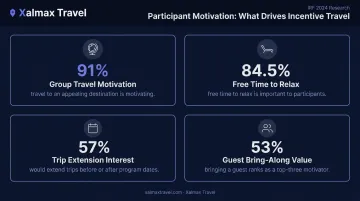
That data points to one clear design principle: control matters to participants. Programs that give winners meaningful choices — in activities, in pacing, in who they bring — outperform those that don't.
What Personalization Looks Like in Practice
Leading programs are building flexibility into every layer of the experience:
- Activity menus that range from adrenaline options (skydiving, off-road racing) to restorative ones (cooking classes, sound therapy), letting participants self-select
- Guest inclusion policies that treat a partner's presence as a program feature, built into the design from the start
- Bespoke gifting suites featuring artisan goods from the destination — items that cannot be bought at an airport gift shop
- Personalized recognition moments embedded throughout the program, not just at the gala dinner
The generational dimension matters here too. 67% of incentive professionals agree that younger qualifiers will require a significant retool of how incentive travel is designed, according to the same IRF research. Programs that worked for Baby Boomer sales teams often miss the mark entirely for Millennial and Gen Z high performers who prioritize authenticity, flexibility, and personal relevance over formal ceremony.
That generational shift also has budget implications. IRF research shows that achieving the same performance lift with cash can require up to 3x more spending than with non-cash rewards. A well-designed experiential program delivers stronger motivation at a lower cost per outcome — which matters when justifying the program to finance.
For planners managing this complexity, the intake process matters. Xalmax Travel's venue sourcing process begins with a structured needs assessment — capturing budget, group size, preferred destination, and specific requirements — so that property recommendations reflect the program's personalization goals from day one.
Key Trend 2: Wellness, Sustainability, and Cultural Immersion
The incentive travel industry talks a lot about wellness and sustainability. The participant data tells a more nuanced story — and planners who understand the distinction will design better programs.
What Participants Actually Value
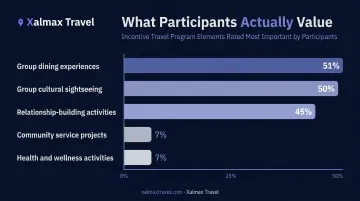
IRF's 2024 attendee data is specific about which program elements drive motivation:
| Program Element | % Ranking It Among Most Important |
|---|---|
| Group dining experiences | 51% |
| Group cultural sightseeing | 50% |
| Relationship-building activities | 45% |
| Community service projects | 7% |
| Health and wellness activities | 7% |
Wellness and CSR aren't irrelevant — they work best as opt-in enhancements, not program centerpieces. Mandatory sound baths and group volunteering sessions rank at the bottom of participant motivation data. Shared meals in extraordinary settings and genuine cultural exploration rank near the top.
Cultural Immersion as a Core Design Strategy
Authentic cultural programming serves a specific motivational function: it creates stories. A private dinner inside a UNESCO World Heritage Site or exclusive access to a local cultural institution gives participants experiences worth talking about — and that story value drives future performance motivation.
This is where destination choice intersects with program design. A resort bubble in Cancun delivers sun and amenities. A curated program in Lisbon or Kyoto delivers both, plus the depth of experience that makes the trip memorable years later.
Destination depth also connects to a growing planning pressure. 23% of incentive buyers cite increased sustainability focus as a long-term challenge, and 18% are questioning whether long-haul travel remains justifiable on climate grounds. For companies with visible ESG commitments, these are real factors in destination selection. Including locally sourced elements and community-rooted programming addresses those concerns without compromising experience quality.
Key Trend 3: Exclusivity and the Experience Arms Race
There is an uncomfortable reality in luxury incentive travel right now: destinations that felt aspirational a decade ago are now accessible to anyone with a travel budget and a good flight deal. Hawaii, Paris, and the Amalfi Coast appear on millions of Instagram feeds. For top performers who travel independently, showing up to an incentive trip and thinking "I could have booked this myself" is a program failure.
That's why leading programs have moved beyond beautiful locations — the differentiator now is access that money alone can't easily buy.
What Exclusivity Actually Means in 2025
- Full property buyouts: sole occupancy of a boutique hotel or resort, removing all strangers from the experience entirely
- After-hours access: private curator tours of world-famous museums, Michelin-starred restaurant buyouts, front-row F1 experiences from private lounges
- Deliberately small qualifier groups to create genuine rarity and perceived prestige
- Bespoke keepsakes: commissioned artwork, custom-blended wines, or handcrafted items tied to the destination that can't be purchased independently
What Programs Are Spending
The most reliable current benchmark comes from the 2024 Incentive Travel Index: the global average per-person spend is $4,900, with North American programs averaging $5,400. Budget typically splits across hotels (27%), airfare (22%), and food and beverage (18%).
38% of incentive buyers cite rising costs and inflation as a primary concern — meaning per-person budgets are under real pressure even as expectations rise. The practical response most leading programs are adopting: smaller qualifying groups with higher per-person investment, rather than large groups with diluted experiences.
Destination ambition is rising to match. 70% of buyers are actively seeking destinations they haven't used before, reflecting the push toward less-familiar, higher-prestige markets.

What's Driving the Rise of Luxury Corporate Incentive Travel
Luxury incentive travel has moved from discretionary perk to strategic priority — and the forces behind that shift are structural, not cyclical.
Remote Work and the Human Connection Gap
Distributed teams lost the daily informal interactions that build culture and trust. Incentive trips have stepped into that gap — not just as reward mechanisms but as structured opportunities for high-value human connection. 58% of senior managers now view incentive travel specifically as a culture-building tool, and 52% of buyers place more importance on soft-power outcomes like engagement and relationships than on financial ROI alone.
AI-Driven Isolation
The 2025 KPMG/University of Melbourne global study on AI found something striking: 83% of people are concerned about losing human interaction and connection due to AI use, 50% report using AI tools instead of collaborating with peers or supervisors, and 20% say AI has reduced their workplace communication and collaboration. As AI automates more routine work, genuine human connection grows harder to manufacture inside the normal workday. Incentive travel is one of the few corporate formats built entirely around that experience.
The Retention Equation
That erosion of connection has a direct cost. Gallup's research puts voluntary turnover at $1 trillion annually for U.S. businesses, with replacement costs ranging from 0.5x to 2x an employee's annual salary. At a $4,900–$5,400 per-person incentive travel benchmark, the math strongly favors investment in retention programming — particularly for high-performing revenue generators whose departure cost is disproportionately high.
52% of employees who left voluntarily said their manager or organization could have done something to prevent it. Recognition programs, including incentive travel, directly address that gap.

Performance as Self-Funding Investment
Well-designed incentive programs tie qualification to measurable metrics — sales quotas, revenue targets, project milestones. IRF research shows incentive programs can increase sales performance by 10–20% when designed with clear performance linkages. For planners defending budget to leadership, that performance lift is the clearest case to make: the trip pays for itself before anyone boards a flight.
How These Trends Are Reshaping Corporate Programs — and What Planners Should Do Next
Destination Selection Is Now a Brand Statement
Where you take your top performers communicates something about what achievement means at your company. Innovation-forward cultures gravitate toward Japan, Barcelona, or Iceland. Prestige-focused programs lean toward Saint-Tropez, the Maldives, or private Caribbean islands. The destination must earn its place in the program logic — not just be convenient or familiar.
For planners managing these decisions without a dedicated team, Xalmax Travel's free venue sourcing service handles destination research, RFP distribution, and contract negotiation — funded by hotel commissions, with no cost to the client.
Tying Incentive Travel to Measurable ROI
Finance teams and senior leadership increasingly require programs to demonstrate measurable value. Planners who frame incentive travel as a culture investment — without connecting it to defined performance metrics — will face shrinking budgets.
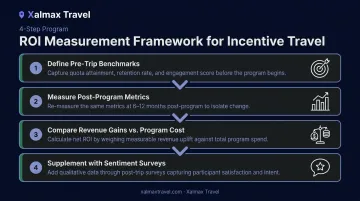
Build your ROI framework before the program launches:
- Define 2–3 pre-trip performance benchmarks (quota attainment, retention rate, engagement score)
- Measure the same metrics 6–12 months post-program
- Compare incremental revenue gains against total program cost
- Supplement quantitative data with post-trip sentiment surveys
Present results in investment language, not event-planning language. "The program generated $X in incremental sales at a cost of $Y per qualifier" lands differently than "participants rated the experience 9.2 out of 10."
Building Inclusivity Into the Program from the Start
Today's qualifying pools are more diverse than President's Club programs were built to accommodate. Proactively address:
- LGBTQ+-friendly destination screening
- Accessibility compliance at venues and during activities
- Dietary and cultural accommodations at all F&B functions
- Activity menus that serve multiple fitness levels and preferences
Programs that fail to address these factors risk excluding the very employees they're designed to motivate.
The Shift Toward Smaller, Higher-Impact Programs
Rather than one large annual trip with broad qualification, companies are moving toward smaller qualifying groups — 15 to 30 people — with elevated, hyper-curated experiences. Smaller groups enable full property buyouts, more intimate programming, and a level of per-person investment that isn't achievable at scale. They also increase the aspirational pull of the program: qualifying becomes genuinely competitive when the group is small.
Multi-destination itineraries and luxury cruise formats are gaining traction as differentiated alternatives to static resort stays, offering built-in novelty and a richer range of cultural exposure within a single program.
Frequently Asked Questions
What makes luxury corporate incentive travel different from a regular company trip?
Incentive travel is earned through measurable performance and designed to inspire future achievement — not just recognize past effort. Unlike standard business travel or team off-sites, these programs are built around rare, exclusive experiences tied directly to individual recognition and organizational goals.
How do companies measure the ROI of luxury incentive travel programs?
ROI is typically measured by tying the program to pre-defined metrics — sales growth, retention rates, post-trip engagement scores — and comparing incremental gains against total program cost. Post-trip sentiment surveys add qualitative depth. Programs with clear performance linkages consistently generate stronger, more defensible ROI data.
How much do companies typically spend per person on luxury incentive travel?
The most current industry benchmark is $4,900 globally and $5,400 in North America, sourced from the 2024 Incentive Travel Index. Budget varies significantly based on group size, destination, and experience level — smaller qualifying groups generally allow higher per-person investment and more elevated experiences.
What are the most popular destinations for luxury corporate incentive travel right now?
Participant research points to Hawaii, Western Europe, and Central America as consistently preferred regions. Current trending destinations from trade sources include Lisbon, Maui, Thailand, Southern Africa, and Cusco/Machu Picchu — the strongest choice is the one your specific qualifiers find genuinely aspirational.
Can smaller companies afford to run luxury incentive travel programs?
Yes — smaller programs often outperform larger ones because limited group size creates genuine exclusivity. A carefully designed trip for 15 top performers can be more motivating than a large group event. Working with a free venue sourcing service like Xalmax Travel gives smaller teams access to the same premium properties and negotiated rates as enterprise clients, with no added planning costs.
What is the difference between incentive travel and a corporate retreat?
Incentive travel is performance-based and earned — it recognizes individual top achievers and is designed to motivate future performance. Corporate retreats typically involve a broader team and focus on strategy, alignment, or culture-building rather than individual recognition. Both serve important purposes, but they operate on fundamentally different program logic.